
Views: 0 Author: Site Editor Publish Time: 2026-09-03 Origin: Site


Transporting a 100-ton mining excavator or an industrial transformer isn't just driving; it is a high-stakes physics experiment on wheels. In the heavy transport industry, a single miscalculation in weight distribution or axle configuration inevitably leads to catastrophic equipment failure, severe damage to road infrastructure, and crippling legal penalties. You simply cannot afford guesswork when dealing with extreme payloads.
Looking closely at current industry trends, the global push for renewable energy and the rapid expansion of large-scale civil engineering projects have fundamentally shifted heavy haulage dynamics. We are seeing a massive surge in the transportation of wind turbine nacelles, grid-scale transformers, and oversized bridge beams. Consequently, highway authorities worldwide are enforcing strict bridge formulas and axle weight limits more rigorously than ever before. Logistics companies are rapidly moving away from marginally compliant, older setups. Instead, fleets are investing in highly specialized multi-axle configurations engineered to legally and safely manage 100+ ton payloads across diverse jurisdictions. When you are dealing with massive payloads ranging from 80 to 120 tons, standard flatbed or step-deck trailers lack the structural integrity and dynamic weight distribution capabilities required for the job.
Logistics managers and fleet engineers constantly face one critical question: Exactly how many axles do we need to safely and legally move this much weight? Configuring the ultimate low-profile heavy hauler is a matter of strict mathematics, material science, and physics. The required axle count depends entirely on cargo weight, individual axle capacity, and regional road stress regulations. This comprehensive guide breaks down the exact configurations needed for massive payloads, highlights the mechanical benefits of specialized setups, and provides objective, engineering-backed criteria to help you spec the correct trailer for your operations.
Precise Axle Mathematics: An 80-ton payload typically demands a 6-axle or 7-axle configuration. Conversely, safely transporting a 120-ton load requires an 8-axle setup, heavily dependent on specifying heavy-duty 16-ton axles.
Mandatory Weight Distribution: Adding axles directly reduces tire-to-ground contact pressure. This is not just a structural recommendation; it is a strict legal requirement to comply with local highway weight limitations.
Trailer Architecture Matters: Utilizing a drop-deck design, particularly a detachable gooseneck, provides the ultra-low center of gravity required for safely loading and hauling tall, top-heavy machinery.
Structural Customization is Crucial: A true high-capacity transport vehicle must be engineered with high-yield strength steel (like Q690), reinforced hydraulic suspensions, and specialized heavy-duty tires to survive extreme operational stress.
Determining the correct number of axles is a fundamental engineering calculation, not a rough estimate. When a dispatch team plans a route, the foundational formula is straightforward: Total Trailer Payload Capacity = Number of Axles × Weight Capacity per Axle. However, applying this formula in the real world requires a deep understanding of dynamic load behavior and specific axle ratings.
In the commercial transport sector, axles are explicitly manufactured to handle maximum downward forces. Exceeding these limits leads to immediate wheel bearing failure and bent axle tubes. Therefore, buyers must rigorously verify the manufacturer's axle ratings.
13-Ton Axles: The baseline standard for general heavy transport. These are cost-effective and suitable for loads up to 60 tons when utilized in standard 4-axle or 5-axle configurations.
16-Ton Axles: Upgraded heavy-duty axles featuring thicker wall tubes and larger brake drums. These are engineered specifically for extreme payloads, offering the heavy-duty braking power required for steep grades.
20-Ton Axles: Specialized off-road or mining axles. While rarely used on standard highways due to asphalt surface regulations, they remain essential for private mining roads and unpaved construction sites.
To transport an 80-ton piece of machinery safely, we apply the capacity formula. If your fleet utilizes standard 13-ton axles, the calculation is 80 tons ÷ 13 tons/axle, equaling approximately 6.15 axles. Since fractional axles don't exist, you must round up. Therefore, a minimum 7-axle setup is required to maintain a safe operational margin. Alternatively, if the trailer is equipped with premium 16-ton axles, a highly robust 5-axle or 6-axle configuration becomes mathematically viable, provided local bridge laws permit the concentrated weight.
When the payload reaches the 100 to 120-ton threshold, mechanical stress on the trailer frame increases exponentially. Relying on standard 13-ton axles for this weight class would require a trailer so long it would be physically impossible to maneuver through standard intersections. By upgrading to 16-ton high-capacity axles, the calculation for a 120-ton load becomes: 120 tons ÷ 16 tons/axle = 7.5.
Consequently, an 8 axle lowbed trailer is the structurally sound and mathematically correct configuration. This specific setup provides a crucial safety buffer. It ensures that no single axle is pushed to its absolute breaking point when traversing uneven terrain, significantly reducing the risk of catastrophic suspension failure mid-transit.
Payload Target | Recommended Axles | Axle Capacity | Suspension Type | Ideal Trailer Architecture |
|---|---|---|---|---|
60 - 80 Tons | 5 to 6 Axles | 13-Ton / 16-Ton | Mechanical / Air | Step-Deck / Fixed Neck |
80 - 100 Tons | 6 to 7 Axles | 16-Ton | Hydraulic | Removable Gooseneck (RGN) |
100 - 120 Tons | 8 Axles | 16-Ton / 20-Ton | Hydraulic Articulated | RGN with Dolly / Booster |
A common, and dangerous, misconception in heavy haulage is that if the main steel beams are thick enough, the axle count doesn't matter. This is factually incorrect. You cannot simply place a massive payload on a standard 4-axle frame. The true limitation lies in weight distribution and how the tires interact with the asphalt.
Governments strictly regulate axle weights for one primary reason: to protect public infrastructure. The engineering concept of tire-to-ground contact pressure is vital here. If 120 tons are concentrated over just four or five axles, the downward pressure exceeds the compressive strength of standard road surfaces. This concentrated point-load leads to severe rutting, cracking, and the eventual collapse of bridge decks. By utilizing a multi-axle heavy equipment trailer, the immense weight is spread over a much larger surface area, lowering the contact pressure per square inch to legally permissible levels.
Furthermore, weight distribution directly dictates the physical control a driver maintains over the vehicle. More axles inherently mean more tires gripping the road, and crucially, more brake drums. Imagine hauling 120 tons of rolling momentum down a steep 6% mountain grade; stopping power becomes your ultimate safety factor. A multi-axle configuration ensures braking force is distributed across 32 individual tires rather than just 16. This massive increase in friction surface area drastically reduces stopping distances, minimizes brake fade, and prevents the trailer from jackknifing during emergency maneuvers.
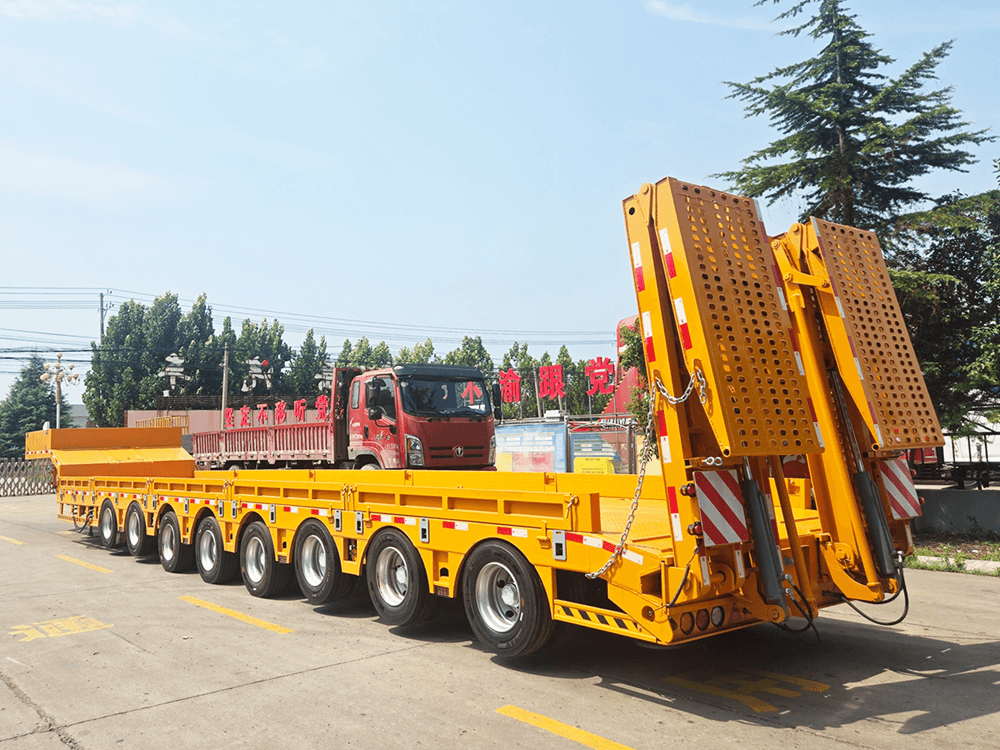
When moving ultra-heavy cargo, the physical architecture of the trailer is just as important as the axle count. The stepped-deck design has become the definitive industry standard for heavy transport due to its unparalleled structural integrity and loading efficiency.
Fleet buyers typically choose between a fixed neck and a Removable Gooseneck (RGN). A fixed model requires machinery to be loaded from the rear, often necessitating long, heavy hydraulic ramps. In contrast, an RGN allows the front of the trailer to detach from the tractor unit. The front of the deck drops directly to the ground, acting as its own low-angle ramp. For front-loading massive tracked vehicles weighing over 80 tons, the RGN is universally recognized as the safest choice. It completely eliminates the need to drive 100-ton machines up steep rear inclines, significantly mitigating the risk of the equipment slipping or tipping backward.
Specifically, the primary physical advantage of a gooseneck lowbed is its drop-deck architecture. By stepping down the deck height between the tractor connection and the rear axles, the cargo sits exceptionally close to the ground—often just 12 to 24 inches above the asphalt. Lowering the center of gravity is paramount when transporting tall cargo like industrial transformers. It drastically reduces the centrifugal force acting on the trailer during cornering, virtually eliminating rollover risks while ensuring the load safely clears highway overpasses.
Purchasing a high-capacity transport vehicle requires strict attention to material science. A standard commercial trailer cannot simply be scaled up; it must be purpose-built from the ground up.
The backbone of any 120 ton lowbed trailer is its main beam structure. Standard carbon steel is entirely insufficient for these stress levels; it will flex and permanently deform under point-load stress. Premium manufacturers utilize high-yield tensile steel, such as Q460 or Q690. These advanced metallurgical variants offer exceptional yield strength, meaning the steel can flex under the immense weight of a massive load and return to its original shape without metal fatigue or cracking. The web and flange thickness of the main beams are heavily reinforced, and cross-members are spaced tightly to prevent the deck from buckling.
Suspension systems dictate how the trailer absorbs road shock. While mechanical leaf spring suspensions are cost-effective for lighter loads, they are grossly inadequate for an 8-axle setup carrying 120 tons. If a mechanical spring setup hits a deep pothole, some axles may hang in the air while others bear double the weight, leading to instant failure.
For ultra-heavy loads, hydraulic suspensions are non-negotiable. A hydraulic suspension system allows individual axles to articulate independently. The hydraulic fluid actively shifts to equalize the pressure across all other axles, ensuring the 120-ton weight remains evenly distributed over uneven terrain. Many advanced systems offer a lifting stroke of +/- 300mm, allowing operators to raise or lower the deck to clear obstacles.
One of the most common applications for high-capacity lowbeds is the transportation of massive construction and mining excavators, such as the CAT 390F or the Komatsu PC800. Moving these machines presents unique dimensional challenges.
Large excavators are exceptionally wide, often exceeding the standard 8.5-foot width of a commercial trailer deck. A dedicated excavator transport trailer must feature heavy-duty swing-out outriggers or side extensions. These thick steel brackets expand the usable width of the deck, allowing the wide steel tracks to sit securely. Additionally, the deck is often reinforced with hardwood or high-friction steel plating to prevent metal-on-metal sliding. Ground clearance is equally critical; the deck must be low enough to accommodate the towering height of the excavator's boom, keeping the total vehicle height under legal limits.
Loading a 100-ton excavator requires robust hardware. If utilizing a rear-loading model, standard spring-assisted manual ramps will instantly crush under the initial concentrated weight of the tracks. Heavy-duty, dual-action hydraulic ramps are mandatory. However, as noted earlier, utilizing an RGN for front-loading is highly preferred by loading crews. It allows the operator to drive straight onto the lowest part of the deck with a minimal incline, maximizing safety and reducing stress on the machine's drivetrain.
Transporting 80 to 120 tons is never a standard operation; it falls strictly under "heavy haul" or "oversize/overweight" (OS/OW) logistics. Operating such equipment requires rigorous adherence to transportation laws.
In North America, Europe, and many other regions, weight limits are governed by specific Bridge Gross Weight Formulas. This regulation dictates not only the maximum weight per axle but also the required distance between those axles. The formula ensures a heavy vehicle does not place all its weight on a single span of a bridge simultaneously. Therefore, spreading the axles further apart (often using a jeep dolly or stinger booster) allows the vehicle to legally carry a heavier gross weight. Logistics planners must calculate this spacing meticulously before dispatch.
Operating a fully loaded 120-ton transport triggers multiple oversize load protocols. These shipments require special municipal or provincial permits, which dictate the exact route to avoid weak bridges. In addition, escort vehicles (pilot cars) are mandatory. One pilot car drives ahead with a height pole, while another follows behind to manage traffic flow. The trailer must be equipped with oversize load banners, safety flags, and flashing amber lights.
A high-capacity trailer is a massive capital investment. To ensure operational safety and prolong the lifespan of the steel and components, rigorous preventative maintenance is required.
Managing tire wear on an 8-axle configuration is a complex logistical task, as you are dealing with 32 or more individual tires (often 235/75R17.5 or 315/80R22.5 specs). Uneven tire pressure is the leading cause of blowouts in heavy haulage. If one tire is underinflated, the adjacent tire carries double the weight, leading to rapid overheating. Fleets should utilize automated Tire Pressure Monitoring Systems (TPMS) and conduct daily visual inspections for tread chunking caused by extreme scrubbing forces during tight turns.
The mechanical components of a multi-axle trailer endure severe friction. Wheel bearings must be repacked with high-temperature grease at strict mileage intervals to prevent seizing. Brake shoes and drums must be inspected frequently, as the immense stopping forces cause rapid wear. Finally, mechanics must regularly check the hydraulic suspension and detachable neck for fluid leaks, hose degradation, and micro-fractures around joint pins, ensuring structural integrity under high pressure.
Safely moving massive payloads ranging from 80 to 120 tons requires precise trailer engineering and a deep understanding of weight dynamics. You typically need six to eight axles for safe load distribution, with an 8-axle setup being the optimal, legally compliant choice for handling 120 tons. By investing in a specialized drop-deck or detachable trailer built with high-yield Q690 steel and hydraulic suspensions, logistics companies can lower the center of gravity, accommodate tall machinery, and prevent costly loading accidents.
Ultimately, this level of investment ensures long-term efficiency, safety, and legal compliance for your heavy haul operations. If you are looking to upgrade your fleet's capabilities, take the time to evaluate your specific payload requirements, consult with engineering specifications, and choose premium transport solutions. For custom-engineered, heavy-duty transport trailers designed to handle up to 120 tons, explore the specialized configurations available at chivehicles.com.
A standard 3-axle to 4-axle lowbed trailer is typically engineered to carry between 40 to 60 tons. To safely exceed 80 tons, specialized multi-axle configurations and reinforced high-yield steel structures are mandatory.
In the heavy transport industry, standard commercial axles are rated for 13 tons. Heavy-duty variants, designed specifically for extreme payloads and mining applications, can handle 16 to 20 tons per axle safely.
To prevent structural frame failure and comply with stringent highway weight limits, 120 tons must be distributed across multiple contact points. Utilizing eight 16-ton axles ensures the trailer can bear the extreme load safely while protecting road infrastructure from concentrated pressure damage.
Yes. A gooseneck model features a significantly lower deck height. This drop-deck design is essential for accommodating tall machinery, lowering the vehicle's overall center of gravity, and remaining under highway bridge height limitations.
It depends entirely on the excavator's weight and track width. Large mining excavators require a dedicated transport trailer equipped with side outriggers, reinforced friction decking, and specific axle counts to handle the highly concentrated track weight without buckling the deck.
Mechanical leaf spring suspensions are static and distribute weight poorly over uneven ground, which can cause individual axles to overload and snap. Hydraulic suspensions use fluid cylinders to allow each axle to articulate independently, actively equalizing the weight across all tires regardless of potholes or uneven terrain, making them mandatory for 100+ ton loads.
Bridge formula compliance is calculated using the Federal Bridge Gross Weight Formula, which factors in the overall gross weight of the vehicle, the number of axles, and the precise distance (spacing) between the extreme axles of any specific group. To carry more weight legally, fleets often use jeep dollies or stingers to increase the distance between axle groupings, spreading the load over a longer span of the bridge.


