
Views: 0 Author: Site Editor Publish Time: 2026-09-16 Origin: Site


Imagine a 56cbm rig navigating a 6% downhill highway grade in mid-July. Or perhaps it is maneuvering through a tight, congested industrial park. In these high-stakes scenarios, transporting highly flammable, pressurized gas demands zero compromises. For fleet managers and field engineers, specifying the right equipment is the most critical risk management decision on the table. The unforgiving physics of liquefied gases dictate that any transport vessel must be meticulously engineered. It has to withstand extreme internal pressures, dynamic liquid surges, and harsh operating environments.
Investing in a high-quality gas transport semi trailer is not just a standard procurement task. It forms the foundation of a secure, profitable supply chain. It protects your drivers, ensures strict regulatory compliance, and maximizes your daily payload yield. Are you expanding a regional delivery network or phasing out aging, overweight units? Either way, understanding the mechanical engineering behind these massive vessels is paramount. This guide strips away the marketing fluff. We provide an evidence-based, practical framework to help you select the exact equipment you need based on volumetric capacity, pressure ratings, and mandatory safety features.
Capacity Matching: Selecting between 40cbm, 56cbm, and 60cbm configurations depends entirely on your route topography, bridge laws, and local gross vehicle weight (GVW) limits.
Pressure & Metallurgy: Authentic pressure vessels must utilize high-yield carbon steel (Q345R or Q370R) to safely contain intense vapor pressures and temperature-induced expansion without adding dead weight.
Non-Negotiable Safety: Advanced configurations—including pneumatic emergency shut-off valves, SRVs, and internal anti-wave baffles—are mandatory for mitigating catastrophic rollover and explosion risks.
Manufacturing Quality: Reliable procurement requires verifying factory QA protocols, specifically 100% X-ray Non-Destructive Testing (NDT) and high-pressure hydrostatic testing.
Regulatory Compliance: Ensure your equipment explicitly meets local and international codes (ASME U-stamp, DOT MC331, ADR) to avoid severe legal penalties.
Before looking at technical spec sheets, you must conduct a rigorous analysis of your operational environment. The cargo's physical properties and the harsh reality of your delivery routes set the baseline for your equipment.
The total distance of your typical route directly dictates your trailer choice. Long-haul transport across flat interstate highways favors maximizing payload to drop the cost-per-ton-mile ratio. In contrast, regional distribution often involves tight rural gas stations or narrow urban streets. These routes demand shorter wheelbases and aggressive maneuverability. You must sit down with local bridge laws and GVWR limits before selecting a tank size. Pushing a fully loaded rig over an axle weight restriction invites hefty DOT fines. Worse, it accelerates structural wear on the chassis.
From a chemical standpoint, LPG is rarely a uniform product. It is usually a tailored mixture of propane and butane, and their specific gravity varies wildly. For instance, commercial propane generates a much higher vapor pressure than denser butane. Because these liquids expand rapidly as ambient temperatures rise, tanks are never filled to 100% capacity. A strict vapor space—known in the industry as outage—must be maintained.
Consequently, an LPG propane tank trailer must be engineered specifically for the maximum vapor pressure of its intended cargo. Propane's high volatility requires thicker steel shells and elevated design pressures compared to vessels built strictly for butane. Knowing your exact chemical composition is the non-negotiable first step.
Matching the geometric volume of the tank to your logistics model is crucial for maximizing ROI. The global market offers several standardized capacities. Here is a practical breakdown to guide your selection:
Tank Capacity | Ideal Application | Typical Axle Setup | Core Engineering Advantage |
|---|---|---|---|
40cbm (Agile) | Urban delivery, mountainous terrain, tight industrial parks. | 2-Axle / 3-Axle | Short wheelbase provides a superior turning radius and easily clears strict local GVW limits. |
56cbm (Standard) | Regional distribution, standard highway transport. | 3-Axle | The industry sweet spot. Balances maximum legal payload yield with standard highway maneuverability. |
60cbm+ (Bulk) | Long-haul, cross-country terminal-to-terminal transport. | 3-Axle / 4-Axle | Drastically reduces cost-per-ton-mile for bulk distributors. Requires specialized heavy-duty chassis. |
Engineered primarily for agility, the 40cbm configuration is highly suitable for short-distance distribution. This size shines in regions with challenging mountainous terrain. The shorter overall length provides a tighter turning radius, making it the preferred choice for delivering gas to facilities where cumbersome 60cbm trailers simply cannot navigate.
For the vast majority of commercial gas fleets, the 56cbm capacity represents the optimal choice. It offers an ideal balance between payload profitability and maneuverability. Distributors can transport a substantial volume of liquid gas, maximizing the yield for each trip, while still safely adhering to standard tri-axle weight regulations in most jurisdictions.
Trailers boasting capacities of 60cbm and higher are designed almost exclusively for long-haul transport between major storage terminals. These massive vessels drastically reduce transportation overhead. However, accommodating this immense volume requires specialized multi-axle configurations to legally distribute the crushing weight of the liquid cargo across the pavement.
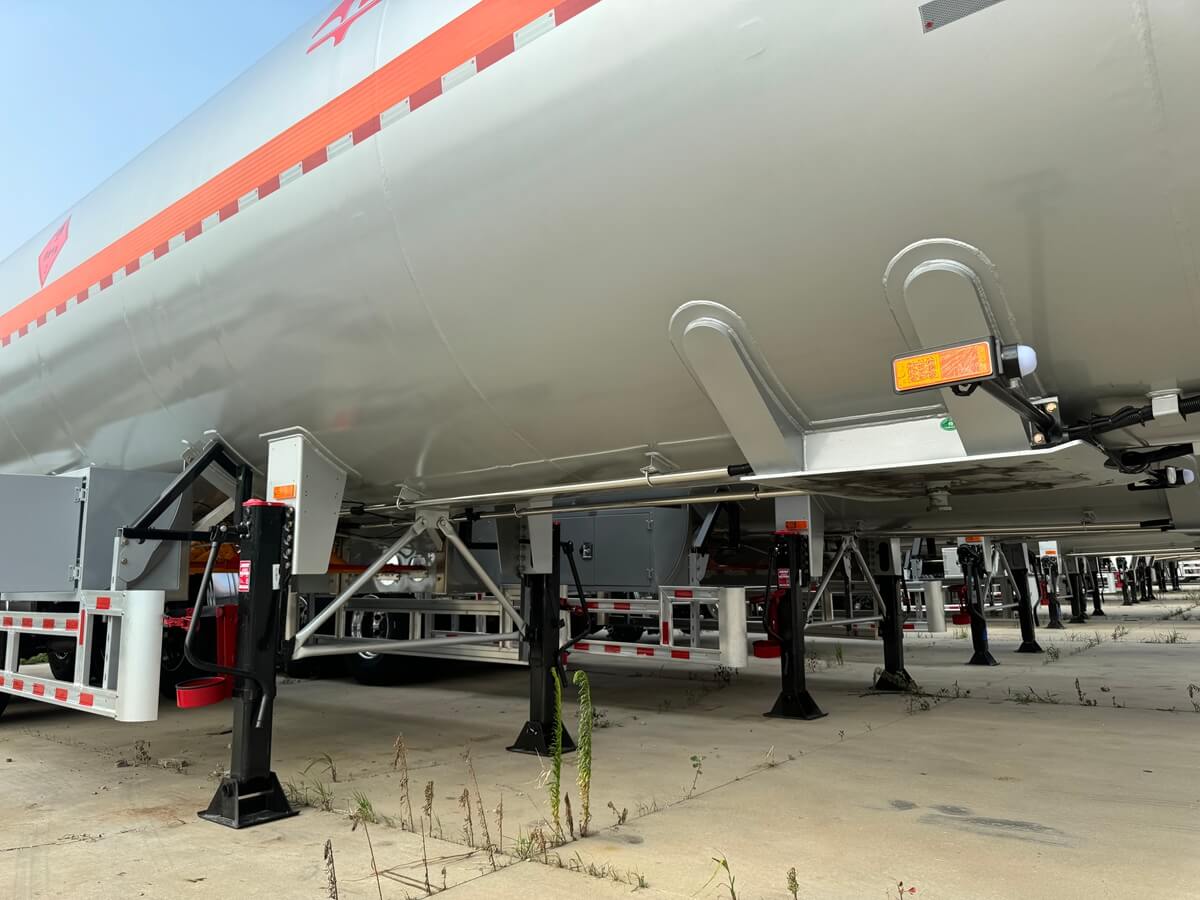
The structural integrity of a mobile pressure vessel is its ultimate safety foundation. Because the cargo is stored under intense pressure, the steel shell must contain massive internal forces that fluctuate wildly with ambient weather conditions.
Engineers must distinguish between operating pressure and design pressure. Operating pressure is the actual force exerted by the gas during day-to-day transit. However, an ASME LPG tanker is engineered with a Design Pressure—often referred to as Maximum Allowable Working Pressure (MAWP)—that is substantially higher. For standard propane transport, MAWP is typically set around 1.61 MPa (approx. 233 psi). This elevated threshold provides a critical safety margin, accommodating severe thermal expansion if the trailer is parked under direct summer sun.
To safely contain these immense pressures without adding crippling dead weight, manufacturers utilize specialized high-tensile carbon steel plates. Materials such as Q345R or Q370R are the gold standards. The "R" designation denotes steel specifically formulated for pressure vessels. It offers superior yield strength, tensile durability, and low-temperature impact toughness. Shell thickness usually ranges from 10mm to 12mm, with dish heads up to 14mm. While thicker steel inherently increases the safety margin, it simultaneously increases tare weight. Precise mathematical engineering is required to optimize the payload.
Transporting hazardous materials across public infrastructure requires redundant, fail-safe systems. A modern liquefied petroleum gas trailer is equipped with a sophisticated network of specialized valves designed to prevent catastrophic failures during loading, transit, and unloading.
Serving as the primary line of defense against leaks, emergency shut-off valves are installed directly at the liquid and vapor transfer ports. These valves automatically close and sever the flow of gas in the event of a ruptured loading hose or external fire. Operated via pneumatic systems, they are built to fail "closed." Furthermore, they incorporate fusible links that melt at specific temperatures (usually around 100°C), triggering an immediate mechanical lockdown of the tank's contents during a fire.
Internal pressure can spike to dangerous levels if the tank is accidentally overfilled at the terminal. Safety relief valves are meticulously calibrated to open automatically when internal pressure reaches a predetermined danger threshold. By safely venting excess vapor into the atmosphere, they prevent a structural rupture or a devastating Boiling Liquid Expanding Vapor Explosion (BLEVE). Once the pressure normalizes, the valve firmly reseats itself.
Imagine a fully loaded rig slamming on the brakes. The liquid cargo possesses massive kinetic energy and shifts dynamically. To mitigate this dangerous "sloshing" effect, factories weld internal anti-wave baffles inside the tank. These perforated steel plates divide the vessel into smaller compartments, severely restricting the rapid forward and backward movement of the liquid. This ensures the trailer maintains its center of gravity and prevents deadly rollovers.
What is driving the next generation of LPG transport equipment? Recent industry analyses highlight a massive shift toward "lightweighting" and automated safety integration. As global emission standards tighten and diesel fuel costs surge, fleet operators are demanding higher payload yields without violating strict highway axle load limits. This economic pressure has accelerated the adoption of advanced high-tensile alloys (like Q370R) that shave off unnecessary tare weight while maintaining high MAWP ratings. In addition, there is a clear standardization of Electronic Braking Systems (EBS) and roll-stability programs across emerging markets. These systems are rapidly moving from optional add-ons to mandatory compliance features. These trends underscore a broader industry movement: maximizing per-trip profitability while engineering out human error.
The reliability of a pressure vessel is entirely dependent on the precision of the factory that built it. Savvy fleet managers rigorously vet a manufacturer's quality assurance (QA) protocols before ever signing a purchase order.
The longitudinal and circumferential seams of the tank endure the highest stress. Leading manufacturers utilize automated Submerged Arc Welding (SAW) for these critical joints. SAW produces flawless, deep-penetration welds with uniform consistency. This effectively eliminates the micro-errors associated with manual human welding.
A visual inspection of a weld is completely inadequate for a pressurized vessel. Comprehensive Non-Destructive Testing (NDT) is mandatory. Factories employ Radiographic Testing (X-ray) to inspect 100% of the weld seams for hidden internal defects, such as porosity or micro-cracks. Ultrasonic Testing (UT) is also utilized to measure steel thickness and ensure there is no lamination in the base material.
Before a tank receives its final certification, it must survive brutal physical stress tests. The hydrostatic test involves filling the completed tank entirely with water and pressurizing it to a level significantly higher than its design pressure (typically 1.3 to 1.5 times the MAWP). Following this, an air tightness test is conducted using compressed air and soapy water solutions around all valve fittings to guarantee zero vapor leakage.
Operating an uncertified pressure vessel is a severe legal liability that can bankrupt a distribution business overnight. Your pressure vessel trailer must strictly adhere to the regulatory frameworks of the region in which it operates.
The American Society of Mechanical Engineers (ASME) Boiler and Pressure Vessel Code is the globally recognized benchmark for the design and fabrication of pressure vessels. An authentic ASME-certified tanker is accompanied by a U-stamp data report. This document proves that every single aspect of the tank has been independently inspected and verified by an authorized third-party agency.
Beyond the tank itself, the trailer chassis must meet transportation authority standards. In the United States, the DOT enforces specifications such as the MC331 code. In Europe and international markets, the ADR governs these standards. These regulations dictate mandatory road safety features, including ABS, specific lighting configurations, and heavy-duty rear-end crash protection bumpers designed to shield the discharge valves during a collision.
Procuring specialized transport equipment requires significant capital. Fleet managers must weigh the financial and operational implications of purchasing versus leasing based on their specific business lifecycle.
Purchasing a trailer outright is the most cost-effective long-term strategy for established fleets with consistent, year-round contracts. Ownership builds equity and provides a higher ROI. More importantly, buying grants fleet managers the freedom to request custom configurations—such as specific valve placements, custom baffle designs, or specialized axle setups—tailored precisely to their operational infrastructure.
Conversely, leasing is a strategic alternative for companies facing seasonal spikes in propane demand, such as the sudden surge in heating requirements during harsh winter months. Short-term leasing allows fleets to scale their capacity dynamically without committing to massive upfront capital expenditures. It also shifts the burden of long-term maintenance and 5-year hydrostatic re-testing back to the leasing company.
Choosing the right equipment for your gas distribution fleet is a strict engineering calculation. You must align the correct volumetric capacity with your route logistics, ensure robust pressure ratings through high-tensile materials, and implement top-tier safety configurations to protect your drivers.
Look beyond the initial price tag. Focus heavily on manufacturing quality control—such as automated SAW welding and rigorous NDT testing—to secure an asset that will deliver decades of reliable service. Never compromise on regulatory compliance or emergency shut-off systems. If you are looking for a reliable, fully certified transport solution tailored to your specific payload and safety requirements, explore the high-performance inventory at CHI Vehicles. Their specialized engineering teams can help you specify the exact equipment match to maximize your fleet's efficiency and safety.
Typically, a high-quality unit will remain in active commercial service for 15 to 20 years. However, this lifespan is heavily dependent on the frequency of use, strict adherence to routine maintenance schedules, and the baseline metallurgical quality of the carbon steel utilized during its initial manufacturing.
Regulatory bodies enforce stringent inspection intervals to ensure public safety. Generally, mandatory visual and leakage inspections must be conducted annually. Furthermore, strict hydrostatic testing and comprehensive internal visual inspections are legally required every 5 years under most DOT and ASME regulations to verify ongoing structural integrity.
Generally, no. While both substances require pressurized transport, their specific design pressures, valve materials, and safety configurations differ drastically. For example, anhydrous ammonia is highly corrosive to the brass and copper fittings commonly used in LPG systems. Fleets must strictly use dedicated trailers for specific chemical compounds.
An ASME tanker has been engineered, fabricated, and rigorously tested according to the strict codes of the American Society of Mechanical Engineers. This highly coveted certification guarantees a mathematically verified safety margin and independent third-party QA inspections—assurances that non-certified tanks simply cannot legally provide.
Depending on the specific grade of high-tensile steel (like Q345R vs. Q370R), shell thickness, and the axle configuration chosen, a standard 56cbm trailer typically has a tare weight ranging between 13,000kg and 15,000kg. Advanced lightweighting techniques can push this closer to the lower end, maximizing your legal liquid payload.
Anti-wave baffles act as physical breakwaters inside the tank. When a truck brakes or turns sharply, the liquid cargo attempts to surge forward or sideways. The perforated baffle plates disrupt this kinetic energy, slowing the fluid's momentum. This prevents violent weight transfers, maintaining the trailer's center of gravity and significantly reducing the risk of a rollover.


