
Views: 0 Author: Site Editor Publish Time: 2026-09-21 Origin: Site


Investing in a dump trailer isn't just about buying a steel box on wheels. It is a profound game-changer that drastically boosts your hauling efficiency on the job site. Make no mistake, though—purchasing the wrong size quickly leads to dangerous overloading scenarios, severe DOT fines, and heavily reduced profit margins per trip. Hauling incredibly dense materials, such as wet sand or raw mining ore, requires a completely different set of mechanical specifications than moving bulky, lightweight demolition debris. In this comprehensive guide, we will break down the exact material weight formulas and structural requirements you need to confidently choose the perfect transport solution for your daily operational demands.
Key Takeaways
Volume vs. Weight: Sizing your equipment requires a strict, calculated balance between the physical volume (cubic yard capacity) and the Gross Vehicle Weight Rating (GVWR) payload.
Material Density is the Deciding Factor: A trailer designed for sand transport will maximize its legal weight capacity long before the physical box is filled, unlike a unit hauling demolition waste.
Heavy-Duty Engineering: Mining and heavy aggregate transport mandate specialized engineering, such as high-tensile steel floors and multi-axle configurations capable of distributing massive loads.
Lift Mechanisms Matter: The lifting power and cylinder design of your hydraulic system must align seamlessly with your maximum payload to ensure safe, stable dumping on uneven terrain.
Legal Compliance: You must always match your trailer’s GVWR with your towing vehicle's capacity to remain Department of Transportation (DOT) compliant and avoid catastrophic mechanical failures.
Selecting the right transport equipment is a critical operational decision. It extends far beyond simply pointing at the longest bed on the dealership lot. Proper sizing involves meticulously matching the mechanical engineering, axle ratings, and structural integrity of the unit to the specific materials you intend to haul. Failing to do this inevitably leads to accelerated mechanical wear. In the field, we constantly see premature suspension failures, severe safety hazards on public roads, and bleeding profitability due to highly inefficient trips when equipment is mismatched.
Looking at recent commercial hauling trends, fleet managers are rapidly abandoning the outdated "one-size-fits-all" mentality. Driven by stricter DOT weight enforcement and volatile fuel costs, the market is seeing a massive shift toward task-specific, lightweight yet high-strength trailers. Operators are heavily investing in units engineered with advanced steel alloys—like T700 or HARDOX—to maximize legal payload capacity without adding dead tare weight. The modern engineering philosophy is simple: every drop of diesel must translate directly into profitable material moved, not just pulling a heavy, overbuilt chassis.
To size your equipment accurately, you must grasp the fundamental difference between weight capacity and physical volume. The Gross Vehicle Weight Rating (GVWR) is the absolute maximum weight a trailer can safely handle when fully loaded. Payload capacity is simply that GVWR minus the empty weight (tare weight) of the trailer itself. For instance, a unit with a 14,000 lb GVWR that weighs 4,000 lbs empty yields a maximum legal payload of 10,000 lbs.
Conversely, volume is measured in cubic yards. It represents the literal physical space inside the trailer box. The golden rule of hauling heavy aggregates? You will almost always hit your payload weight limit long before you fill the physical volume of the bed. Filling a high-sided unit to the brim with incredibly dense materials like wet dirt or gravel guarantees severe, dangerous overloading.
Exceeding the payload capacity of a hydraulic tipper trailer introduces significant mechanical risks that can cripple a business. From an engineering standpoint, pushing past the weight limit places immense, undue stress on the leaf springs, axles, and tires. This daily abuse frequently leads to premature tire blowouts on the highway and permanently bent suspension components.
Beyond the suspension, the hydraulic lifting cylinder is rated for a very specific tonnage. If the payload drastically exceeds this rating, the hydraulic pump will simply fail to lift the bed. In worst-case scenarios, the cylinder could buckle under the immense pressure during the discharge cycle. From a safety perspective, an overloaded rig drastically increases braking distance and raises the center of gravity, making the entire setup highly susceptible to highway-speed rollovers.
Eliminating guesswork is the single most effective way to choose the right trailer size. By utilizing standard material density metrics, operators can mathematically determine the exact cubic yardage a specific unit can legally and safely carry. This protects both the transport equipment and the drivers.
Different materials exert vastly different weights per cubic yard. Before finalizing any purchase, rigorously evaluate your primary cargo. Below is a core reference table detailing the estimated weights of common hauling materials. Use this as your baseline for calculations.
Material Type | Estimated Weight per Cubic Yard (lbs) | Hauling Characteristic |
|---|---|---|
Construction Debris (Wood, Drywall) | 400 - 600 lbs | High Volume, Low Density |
Topsoil (Dry) | 2,000 - 2,200 lbs | Medium Volume, Medium Density |
Gravel (Loose) | 2,400 - 2,900 lbs | Low Volume, High Density |
Sand (Dry) | 2,600 - 2,800 lbs | Low Volume, High Density |
Sand (Wet) | 3,000 - 3,300 lbs | Very Low Volume, Extreme Density |
Mining Ore / Solid Rock | 4,000+ lbs | Extreme Density, High Impact |
Note: Moisture content significantly alters the weight of porous materials like dirt and sand. Always base your calculations on the heaviest potential state of the material to maintain a safe operational buffer.
To determine the physical capacity of your bed, apply the standard cubic yard formula: Length (ft) × Width (ft) × Height (ft) ÷ 27 = Cubic Yards.
Consider a standard bumper-pull unit measuring 14 feet long, 7 feet wide, with 2-foot high sides. Multiplying 14 by 7 by 2 gives you 196 cubic feet. Dividing that by 27 reveals a total physical volume of 7.25 cubic yards. If you were to fill this space level to the top with dry gravel (roughly 2,600 lbs per yard), the material alone would weigh an astonishing 18,850 lbs. A standard 14,000 lb GVWR trailer would be overloaded by nearly 9,000 lbs. This perfectly illustrates why excessively high sides are actually detrimental when hauling dense aggregates.
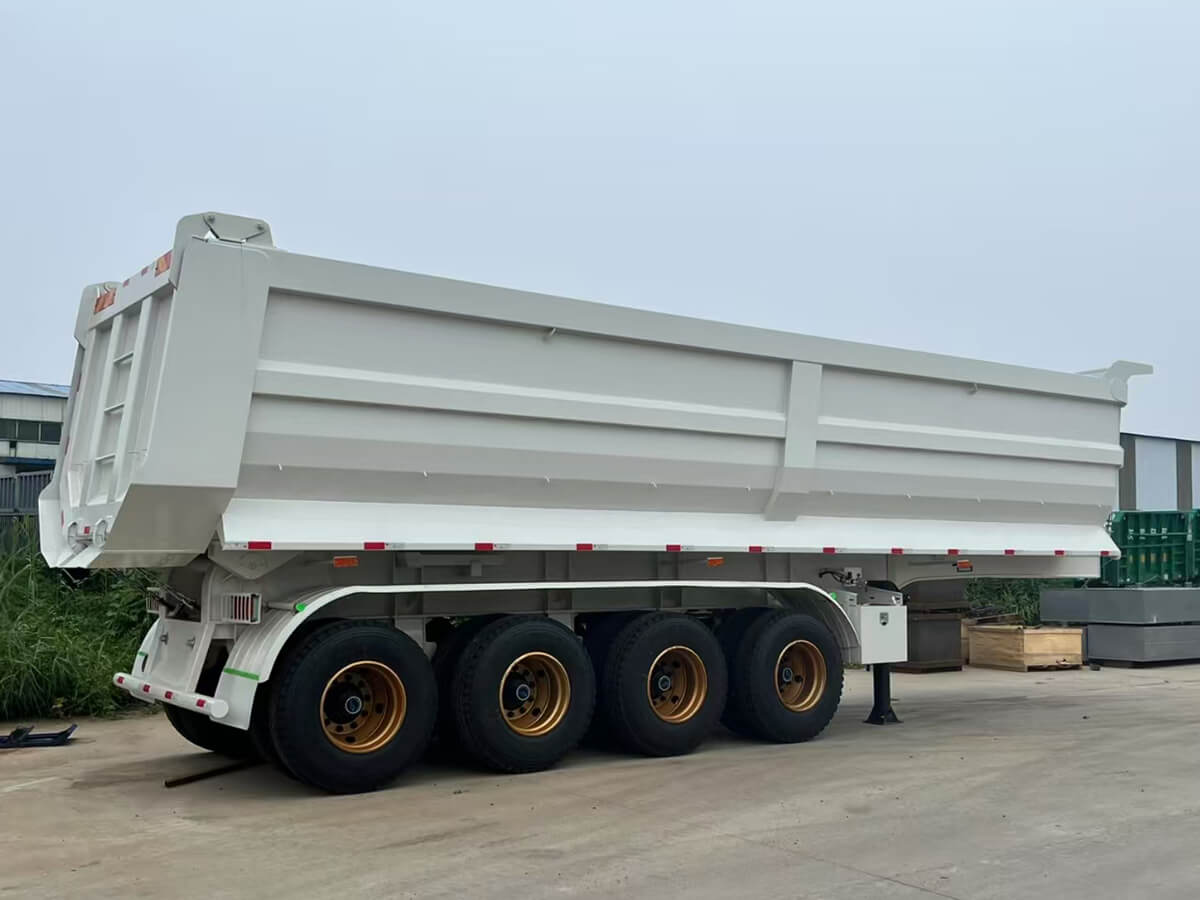
Transporting sand presents a unique set of logistical challenges. Because sand is incredibly dense, highly abrasive, and prone to shifting unpredictably during transit, the equipment must prioritize structural containment and weight distribution over sheer physical volume.
The moisture content trapped within sand grains dramatically alters its hauling profile. While a cubic yard of dry sand weighs a manageable 2,600 to 2,800 lbs, wet sand acts like a massive sponge. Just one cubic yard of soaked sand can tip the scales at up to 3,300 lbs.
When sizing a sand transport trailer, operators must account for this unpredictable variable. If a contractor purchases a unit based strictly on dry calculations, a sudden afternoon downpour on the job site can instantly push the loaded rig far past its legal GVWR. This results in hefty DOT violations and severely compromised braking capabilities.
Because of this extreme density, a dedicated sand hauler (such as a U-shape rear dump semi-trailer) typically features lower side walls or a specialized tub design. This acts as a natural physical fail-safe, preventing loader operators from dumping too much material into the bed and crushing the suspension.
For commercial sand hauling, upgrading to heavy-duty multi-axle configurations is virtually mandatory. Moving to robust 3-axle or 4-axle setups with 13-ton to 16-ton capacities per axle provides the necessary structural backbone. Additionally, these trailers benefit immensely from seamless, high-strength steel floors (typically 6mm to 8mm thickness), ensuring fine, abrasive grains do not leak onto the highway during transit.
Gravel remains the most frequently hauled material for landscapers and civil contractors. While it shares a similar density profile with sand, gravel demands specific structural considerations due to its jagged nature and the aggressive loading methods often used on sites.
The specific type of aggregate directly dictates the required durability of the trailer bed. Small, smooth aggregates like pea gravel distribute their weight relatively evenly and slide effortlessly out of the bed during the dumping cycle.
In stark contrast, dropping heavy, jagged crushed stone (such as riprap or #4 aggregate) from an excavator bucket causes severe impact damage. For crushed stone operations, buyers should prioritize trailers constructed with much thicker wear-resistant steel floors. Standard 10-gauge steel simply won't cut it. Upgrading to 7-gauge or high-tensile steel plates prevents the bed from denting, which otherwise impedes the smooth sliding of materials and leads to rapid, premature rusting.
For standard gravel delivery, the operational "sweet spot" for bumper-pull units typically falls between 12 and 14 feet in length. A well-built 12-foot trailer with a 14,000 lb GVWR offers an outstanding balance of payload capacity and maneuverability, especially when navigating tight residential driveways.
While a 16-foot model undeniably offers more physical volume, filling a bed of that length with gravel almost guarantees catastrophic overloading. For the vast majority of gravel applications, opting for a shorter, heavily reinforced trailer yields much safer, long-lasting results.
When daily operations scale up to heavy industrial mining, large-scale quarrying, or massive earthmoving projects, standard models are no longer sufficient. The extreme density of raw ores and the brutal, unforgiving loading conditions require specialized, commercial-grade machinery.
A mining environment is one of the harshest on earth. Raw mining ore and solid rock easily exceed 4,000 lbs per cubic yard. When massive, multi-ton boulders are violently dropped into the bed from heavy wheel loaders, standard carbon steel will quickly buckle, warp, and tear.
To combat this, true mining trailers utilize high-tensile, abrasion-resistant steel, such as HARDOX 450. This specialized metallurgy absorbs high-impact shocks and aggressively resists scraping wear caused by jagged rocks sliding out during discharge. Many commercial units feature a U-shaped tub design. This prevents rocks from getting wedged in 90-degree corners and significantly lowers the load's center of gravity for enhanced stability on uneven quarry roads.
For open-pit mining and continuous, high-volume quarrying, payload volume equates directly to operational profit margins. In these extreme scenarios, businesses must graduate to massive multi-axle setups.
A specialized 70 ton dump trailer is engineered exclusively for off-road or heavy commercial hauling. These colossal units feature heavily reinforced chassis designs, industrial mechanical suspension systems (with thick leaf springs), and multiple axles to distribute staggering payloads safely. Upgrading becomes necessary when the labor and fuel costs of making multiple trips with smaller equipment far outweigh the initial capital investment of a high-capacity transport solution.
Transitioning away from heavy aggregates into construction waste completely flips the sizing formula on its head. When hauling demolition debris, the primary constraint shifts from weight (payload) to physical volume (cubic yards).
Construction and demolition (C&D) waste—including lumber framing, shattered drywall, roofing shingles, and PVC piping—takes up a massive amount of physical space but weighs surprisingly little. As highlighted earlier, this type of debris averages only 400 to 600 lbs per cubic yard.
If a demolition contractor attempts to use a standard low-sided gravel trailer for this waste, they will quickly "cube out" (run out of physical space) long before they "weigh out" (reach the axle weight limit). This mismatch results in highly inefficient, half-empty trips to the local landfill, wasting both time and fuel.
To maximize per-trip efficiency, demolition crews should invest in a construction dump semi trailer explicitly equipped with high side walls. Walls measuring 1.2 meters to 1.5 meters high allow operators to stack bulky, awkwardly shaped materials without ever threatening the GVWR limits.
The rear gate design is equally crucial for debris management. Traditional spreader gates perform excellently for feathering gravel, but they are terrible for demolition waste. Long pieces of lumber or jagged tree stumps will inevitably jam a spreader gate. A trailer properly designed for debris must feature barn-door style gates that swing fully open, allowing tangled materials to slide out seamlessly without creating dangerous blockages.
The physical dimensions and weight capacities of your equipment are only part of the sizing equation. The operational efficiency of the unit heavily relies on its mechanical and structural engineering. A well-designed trailer must possess a lifting mechanism capable of handling the specified payload and a frame robust enough to withstand repeated, daily stress.
The hydraulic lifting mechanism is the pulsing heart of the trailer. When finalizing your size, you must match the lift type to your primary hauling materials and bed length.
A scissor lift utilizes a single hydraulic cylinder that pushes aggressively against a mechanical linkage. Its primary advantage is lateral stability. When hauling wet dirt or unevenly loaded construction debris that might stick to one side, the scissor mechanism prevents the trailer box from racking or dangerously twisting.
Specifically for commercial heavy-duty applications, front-mounted telescopic cylinders (often utilizing premium brands like HYVA) are the industry standard. They provide a direct, vertical lifting force from the very front edge of the bulkhead. This requires significantly less hydraulic pressure (PSI) to initiate the upward movement compared to center-mounted lifts. For multi-axle semi-trailers hauling maximum payloads, telescopic cylinders stand out as the superior engineering choice.
When hauling highly abrasive materials, the thickness and grade of the steel directly impact the equipment's lifespan.
Regarding the main frame, heavy-duty I-beams (often utilizing Q345B or T700 high-strength steel) offer exceptional vertical load-bearing strength. They aggressively resist downward bending under massive payloads. For the cargo box, upgrading to 6mm or 8mm wear-resistant steel floors ensures the unit can withstand the brutal friction of jagged ores and gravel day in and day out. Standard carbon steel is abandoned entirely in extreme industrial applications in favor of high-tensile plates.
Selecting the perfect trailer size is functionally useless—and legally hazardous—if your truck cannot safely pull, stop, and maneuver the combined weight. The truck and the trailer must always be treated as a single, cohesive mechanical unit.
Every towing vehicle is engineered with a Gross Combined Weight Rating (GCWR), representing the absolute maximum allowable weight of the fully loaded truck and trailer combined. Exceeding this rating places severe stress on the truck’s transmission, braking system, and suspension.
As a general operational guideline:
Half-Ton Trucks (1500 series): Limited to towing 7,000 to 9,000 lbs. Suitable only for small, single-axle units hauling light mulch.
Three-Quarter Ton Trucks (2500 series): Capable of towing 12,000 to 15,000 lbs. Perfect for standard 12-foot to 14-foot dual-axle trailers.
One-Ton Trucks (3500 series): Capable of towing 15,000 to 30,000+ lbs. Required for hauling heavy gravel, wet sand, or operating 16-foot high-capacity trailers.
Semi-Tractors (Class 8): Strictly required for heavy-duty commercial operations, multi-axle semi-trailers, and high-tonnage mining applications reaching 80,000+ lbs combined weight.
Operating heavy transport equipment requires strict adherence to Department of Transportation (DOT) regulations. Sizing your trailer directly impacts your legal classification, licensing requirements, and route planning.
In most jurisdictions, if the GCWR of your truck and trailer exceeds 26,000 lbs, and the trailer's GVWR is over 10,000 lbs, the operator is legally required to hold a Commercial Driver’s License (CDL). Furthermore, heavy commercial setups must adhere to Federal Bridge Gross Weight Formulas, which dictate exactly how weight must be distributed across the axles to prevent catastrophic damage to highway infrastructure. Always verify local and federal laws before finalizing the purchase of high-capacity hauling equipment.
Accurately sizing your dump trailer requires a deep, practical understanding of the specific material weights you encounter daily. Sand and gravel demand high weight capacities and reinforced floors. In contrast, demolition debris requires maximum physical volume and taller side walls to prevent inefficient trips. For extreme earthmoving tasks, heavy-duty mining engineering and high-tonnage multi-axle solutions are the only way to ensure equipment survival.
By carefully matching your trailer’s payload to your towing vehicle's capabilities, you guarantee safe transport, strict DOT compliance, and a highly profitable hauling operation. Ready to upgrade your fleet? Evaluate your operational demands and explore professional-grade transport solutions at CHI Vehicles to find the exact mechanical specifications tailored for your industry needs.
While a standard 14x7x2 foot dump trailer has a physical volume of roughly 7.2 cubic yards, you cannot typically fill it to the brim with gravel. Gravel weighs approximately 2,400 to 2,900 lbs per cubic yard. A 14-foot trailer with a 14,000 lb GVWR generally has a payload capacity of about 10,000 lbs. Therefore, you can legally and safely haul roughly 3.5 to 4 cubic yards of gravel before exceeding the axle weight limits.
A standard dump trailer is typically a bumper-pull or gooseneck unit designed for light to medium-duty trucks (Class 2 through Class 5), with GVWRs ranging from 7,000 to 24,000 lbs. A construction dump semi trailer is a commercial-grade unit designed specifically to be towed by a Class 8 semi-tractor via a fifth-wheel coupling. Semi-trailers are significantly longer, feature pneumatic air brakes instead of electric brakes, and are engineered to handle massive commercial payloads up to the legal highway limit of 80,000 lbs GCWR.
Yes, absolutely. A 70-ton unit is a specialized heavy-haul asset that falls far beyond standard commercial limits. Operating equipment of this magnitude requires a Class A Commercial Driver's License (CDL) with appropriate endorsements. Moving 140,000 lbs of payload usually requires a specialized heavy-duty semi-tractor, multi-axle trailer configurations, and specific oversized/overweight permits depending on local and federal highway regulations.
It is highly discouraged. While a sand hauler is built to handle heavy weight, it is engineered for fine, shifting aggregates and typically utilizes standard commercial steel floors. Mining rocks are large, jagged, and dropped from heights, which will quickly dent, puncture, or warp standard steel. For mining applications, you must use a dedicated mining unit constructed with high-tensile, abrasion-resistant steel to withstand the severe impact and friction of solid rock.
The optimal lift depends heavily on your specific usage. Scissor lifts are generally best for medium-duty trailers (up to 14 feet) because they offer superior lateral stability, which prevents the trailer from twisting if the load is uneven or sticks to one side during dumping. Telescopic cylinders, especially front-mounted designs, are best for longer trailers and heavy commercial payloads because they provide maximum vertical lifting power and operate highly efficiently under extreme weight conditions.
For standard commercial use hauling topsoil or mulch, 10-gauge steel is common. However, for heavy-duty applications like hauling gravel, crushed stone, or sand, engineers highly recommend upgrading to 7-gauge (approx. 4.5mm) or even 1/4-inch (approx. 6mm) high-tensile steel floors. This extra thickness prevents severe denting from excavator loading and extends the lifespan of the trailer.
Routine maintenance is critical for hydraulic longevity. Always ensure the hydraulic fluid is clean and topped off to the manufacturer's recommended level, changing it every 12 to 24 months depending on usage. Inspect the cylinder regularly for weeping seals or deep scratches on the chrome rod, which can introduce contaminants into the pump system. Additionally, always grease the pivot points and hinges to reduce unnecessary mechanical strain on the lifting mechanism.


