
Views: 0 Author: Site Editor Publish Time: 2026-09-09 Origin: Site


In construction transport, time equals money. Faster unloading directly translates to higher fleet profitability, but selecting the right bulk rig is notoriously challenging. Do you prioritize the aggressive cleanout efficiency of a V-shape, or do you need the massive payload capacity of a W-shape? In this comprehensive guide, we break down the fundamental engineering differences between these two dominant designs. We will compare their discharge efficiency, payload capabilities, and overall highway performance from an operational perspective.
Recent market intelligence indicates a definitive shift in construction logistics. As infrastructure projects scale up globally, fleet operators face a tightening squeeze between fluctuating diesel costs and rigid highway axle-weight regulations. The era of one-size-fits-all purchasing is over. Today's industry trend heavily favors data-driven fleet lightweighting and optimization. Consequently, choosing between V-shaped and W-shaped geometries is no longer just a matter of driver preference. It is a strategic maneuver to minimize dead weight, combat rising fuel consumption, and maximize throughput on every single run.
V-Shaped Trailers feature a single steep hopper. They offer excellent gravity-assisted discharge and minimal material residue, making them the standard for 30cbm to 45cbm operations.
W-Shaped Tankers utilize a dual-hopper design. This allows for significantly higher payload capacities (up to 80cbm) and a lower center of gravity, dramatically improving road stability for 4-axle, large-volume transport.
Discharge efficiency is not dictated by shape alone. It relies on the precise synergy between the trailer’s fluidization system, a robust air compressor output (typically 12m³/min), and internal geometric angles.
Selecting the optimal vessel requires evaluating specific field parameters: cargo density, typical haul distances, and the maximum required volume per trip.
Preventative maintenance of the air compressor and fluidization canvas is mandatory to sustain a 1.2 to 1.5 tons/min discharge speed over the equipment's lifespan.
To make an informed purchasing decision, you must first understand the foundational mechanics of these specialized vehicles. These rigs are not simple dumpers. They are highly engineered pressure vessels designed specifically for the transport and pneumatic conveying of dry powder materials like Portland cement, fly ash, and lime powder.
A pneumatic bulk trailer operates on the principles of pressure differential. Unlike standard dump trailers that rely entirely on gravity, these tankers are hermetically sealed. The unloading sequence requires an onboard or external air compressor, usually driven by a diesel engine or PTO.
In the field, unloading isn't just about opening a valve. The compressor pumps high-volume air into the sealed tank, gradually building internal pressure to a specific working threshold. For most standard units, this sweet spot hovers around 0.2 MPa (approximately 29 psi). Once optimal pressure is achieved, the operator cracks open the discharge valves. The resulting differential between the pressurized interior and the external storage silo forces the powder rapidly through the discharge hose and upward into the destination facility.
Dry cement is stubborn. It is a dense, cohesive powder that does not flow naturally. To facilitate movement, these rigs utilize a critical process called "fluidization." Deep inside the lower section of the tank sits a fluidization bed, covered with a specialized permeable canvas or synthetic mesh.
When compressed air is introduced beneath this canvas, it permeates evenly upward. This air mixes with the cement particles, breaking their cohesion and drastically reducing friction. As a result, the solid powder temporarily behaves like a fluid. It flows smoothly toward the lowest point of the tank. The internal angle of the tank is critical here, working in tandem with gravity to direct the fluidized powder efficiently toward the exit valves.
The V-shaped design remains one of the most reliable architectures in construction logistics. Its name comes from its distinct side profile, which visually resembles the letter "V" due to its single, central downward-sloping funnel.
The structural engineering here is centered around a single-cone hopper. Both the front and rear sections of the tank slope steeply downward toward a single central discharge point located at the very bottom.
Because there is only one hopper, the internal fluidization bed is straightforward. Engineers calculate the steep internal angles to deliberately exceed the natural angle of repose of dry cement (typically 40 to 45 degrees). This structural choice ensures that when the material is aerated, gravity aggressively pulls the entire payload toward the singular exit valve. There are virtually no flat surfaces where powder can accumulate.
Pros:
Lower Residual Rate: The primary advantage of a V shaped cement trailer is its exceptional clean-out capability. With a continuous slope and a single exit, the residual rate is often exceptionally low—typically under 0.3%.
Simpler Operation: Managing one discharge valve reduces operator error. It simplifies the unloading process on chaotic, fast-paced job sites.
Easier Maintenance: Crawling into the confined space of a hopper to swap out a blinded canvas is much faster when there is only one chamber to service.
Efficiency for Standard Volumes: For common payloads ranging from 30 cubic meters (cbm) to 45 cbm, this design is structurally sound and highly efficient.
Cons:
Height and Stability Limits: Because the design relies on steep angles leading to a single point, increasing volume requires making the tank taller. A taller tank raises the vehicle's center of gravity, which negatively impacts aerodynamic efficiency and increases rollover risks during sharp turns.
As industrial demands pushed for higher payload capacities, engineers developed the W-shaped design. This architecture directly addresses the volume limitations of the single-cone setup by incorporating a dual-hopper structure, visually forming a "W" profile.
Instead of one massive funnel, this configuration divides the tank into two (or sometimes three) distinct hoppers. Each hopper contains its own dedicated fluidization bed and discharge valve. These multiple exit points connect to a single main manifold pipe that routes the material out of the rig.
By utilizing two shallower cones, manufacturers can stretch the tank horizontally rather than vertically. This geometric shift allows the rig to accommodate significantly more material while keeping the overall height safely within legal highway limits.
Pros:
Massive Payload Capacity: The W shaped cement tanker is the definitive choice for high-volume transport. These units easily accommodate capacities from 50 cbm up to 80 cbm. They are frequently paired with 4-axle setups to maximize the amount of material moved per trip.
Lower Center of Gravity: By spreading the volume horizontally, the W-shape maintains a lower profile. This dramatically improves road stability, axle weight distribution, and overall highway safety.
Material Versatility: The dual-hopper design can often be adapted to carry lighter, more cohesive materials efficiently, provided the bulk density aligns with local axle limits.
Cons:
Operational Complexity: Operators must actively manage multiple valves and monitor pressure across separate hoppers to prevent blockages in the manifold.
Slightly Higher Residual Rate: The central dividing ridge between the hoppers can occasionally trap small amounts of material. If fluidization is not perfectly managed, the residual rate may hover around 0.4% to 0.5%.
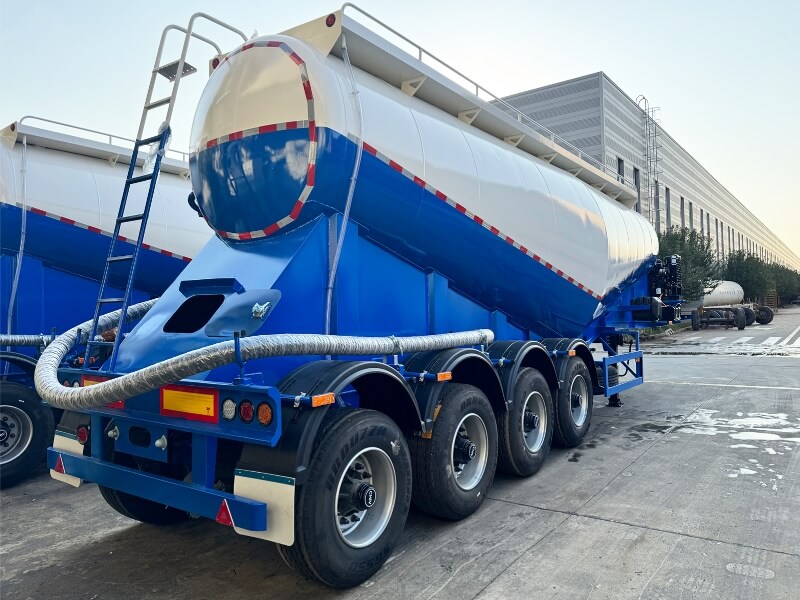
When evaluating discharge efficiency, fleet managers must look beyond just the physical shape. True field efficiency is a combination of unloading speed, pressure retention, and the residual rate left inside the tank.
Under optimal conditions with a standard 12m³/min compressor, both designs can achieve impressive discharge speeds of 1.2 to 1.5 tons per minute. However, their underlying pneumatic dynamics differ significantly.
In a V-shape, air pressure is channeled efficiently to a single bed. The singular focus of the pneumatic force means pressure builds predictably. The operator only needs to monitor one point, resulting in a very consistent, aggressive unloading speed from start to finish.
In contrast, a W-shape requires sophisticated pressure management. Because air must be distributed across multiple beds, the operator must carefully sequence the valves. Typically, one hopper is discharged completely before the other to maintain adequate manifold pressure. If an inexperienced operator opens both valves simultaneously, the pressure drops, material loses fluidization, and discharge speed plummets—often leading to a frustrating pipe blockage.
The residual rate is a critical metric for profitability. Any cement left in the tank represents wasted product, lost revenue, and added "dead weight" burning unnecessary fuel on the return trip. Furthermore, high residue leads to cross-contamination if the trailer switches materials.
Empirical field tests consistently show that V-shaped designs offer superior clean-out. The uninterrupted, steep gravity flow ensures almost every particle is directed to the exit. W-shaped designs, due to the internal divider and complex piping, generally leave a fraction more material behind. While a 0.5% retention rate seems mathematically small, it compounds into tons of wasted payload over hundreds of annual trips.
An efficient unloading process yields diminishing returns if the vehicle cannot safely transport the required volume. Fleet managers must carefully weigh payload capacity against road stability.
The fundamental geometry of a V-shaped rig dictates that to increase payload, engineers must build the tank taller. Consequently, the vehicle's center of gravity (CoG) rises significantly. A high CoG introduces lateral instability, particularly when navigating sharp curves, high winds, or uneven construction terrain. Pushing V-shaped designs into the ultra-high-capacity tier turns rollover risk into a critical safety concern.
Furthermore, the W-shape distributes cargo across two or more separate cones, expanding horizontally. This allows for massive payload capacities while keeping the bulk of the weight closer to the asphalt. For long-haul routes involving high-speed highway driving, the W-shaped design offers superior weight distribution, minimizing driver fatigue and accident risks.
Field data from active fleets suggests clear volume thresholds where one design becomes more practical:
Standard Capacity (30cbm to 45cbm): In this range, the V-shape is highly effective. The height remains manageable, the tare weight stays low, and cleanout efficiency is unmatched.
High Capacity (50cbm to 80cbm+): Once volume exceeds 50 cubic meters, the W-shape becomes the industry standard. Attempting to build a single-funnel trailer for 60cbm results in a dangerously unstable unit. The W-shape efficiently handles these massive loads, making it preferred for large-scale infrastructure projects.
Selecting the optimal dry bulk cement tanker requires a systematic analysis of your operational parameters. A strategic purchasing decision should be based on your typical cargo, geographical routes, and maintenance capabilities.
While both designs handle dry Portland cement perfectly, modern fleets often transport varied powders. Bulk density and particle size play a massive role in fluidization.
Materials with high bulk density and excellent flowability perform exceptionally well in a V-shape due to the steep angle of repose. However, lighter, cohesive materials like fly ash or industrial flour can sometimes bridge or "rat-hole" in a single steep funnel. A high-quality W-shaped dual-hopper design often offers better fluidization for these stubborn materials, as air pressure is distributed across wider beds, ensuring even aeration.
Your typical transport route is a major determining factor:
Short-Haul / Urban Operations: If your fleet operates between local batching plants and tight urban sites, maneuverability is paramount. The shorter wheelbase and single-valve operation of a V-shape make it ideal for navigating city streets and completing multiple quick turnarounds daily.
Long-Haul / Highway Operations: For extended highway routes transporting maximum payloads, the W-shape is vastly superior. The lower CoG ensures stable cruising, and hauling 60cbm or more reduces total trips, optimizing fuel and driver hours.
Feature/Metric | V-Shaped Bulk Trailer | W-Shaped Bulk Tanker |
|---|---|---|
Ideal Volume Range | 30cbm - 45cbm | 50cbm - 80cbm+ (Often 4-axle) |
Center of Gravity | Higher (decreases stability at high volumes) | Lower (excellent stability for heavy loads) |
Discharge Speed | 1.2 - 1.5 T/min (Consistent, single point) | 1.2 - 1.5 T/min (Requires active valve management) |
Residual Rate | Extremely Low (<0.3%) | Low (<0.5%), depends on operator skill |
Internal Complexity | Simple (one hopper, one canvas) | Complex (multiple hoppers and valves) |
Best Use Case | Short-to-medium haul, standard payloads, frequent unloading | Long haul, massive payloads, highway driving |
Even the most precisely engineered powder transport trailer will suffer from degraded discharge efficiency if routine maintenance is neglected. The synergy between the compressor, pneumatic valves, and internal fluidization bed must be preserved. Implementing a strict preventative protocol protects your investment.
The air compressor is the beating heart of the pneumatic system. If it fails to generate adequate volume, fluidization stalls, leading to blocked pipes.
Monitor Operating Pressure: During discharge, internal tank pressure should hold steady around 0.2 MPa. If pressure struggles to reach this threshold, it indicates a system leak or a failing compressor.
Filter Maintenance: Out on a dusty job site, a clogged intake filter chokes the compressor. This drops internal pressure and extends unloading time by precious minutes. Inspect filters weekly.
Valve Integrity Checks: Butterfly valves endure extreme abrasion from high-velocity cement. Inspect the rubber seals monthly. A worn seal allows air to bypass the material, destroying the pneumatic push required to clear hoses.
The canvas at the bottom of the hopper diffuses pressurized air into thousands of micro-streams, aerating the solid powder.
Moisture is the Enemy: The greatest threat to efficiency is moisture. If wet air enters the tank, cement cures and clumps. When cement cakes onto the canvas, it blocks micropores. Always ensure compressor moisture traps function properly.
Proper Tensioning: When replacing the canvas, it must be tensioned correctly. A loose canvas flaps wildly under pressure, causing uneven fluidization and leaving high residue in hopper corners.
The V-shaped design offers unmatched cleanout efficiency and simplicity, making it a reliable workhorse for standard 30-45cbm short-to-medium hauls. Conversely, W-shaped designs provide superior stability and massive payload capabilities (up to 80cbm), serving as the ultimate solution for heavy-duty, long-haul transport. Your final choice depends entirely on your specific cargo volume, route conditions, and operational priorities.
To ensure your fleet operates at peak profitability, you need equipment tailored to your exact field parameters. Evaluate your payload requirements, and visit ChiVehicles (https://www.chivehicles.com) to explore a comprehensive range of premium V-shaped and W-shaped bulk cement trailers engineered for maximum discharge efficiency and durability.
The discharge speed of a well-maintained unit typically ranges from 1.2 to 1.5 tons per minute. However, this metric depends on several variables: the output capacity of the air compressor (usually 12m³/min), maintaining optimal internal pressure (0.2 MPa), hose diameter, and the powder's bulk density. Pumping cement into a 30-meter-high silo takes longer than a 15-meter silo due to increased backpressure.
Based on the average discharge speed of 1.2 to 1.5 tons per minute, a standard 40-ton payload will typically take between 25 to 35 minutes to completely unload under optimal conditions. This timeframe can extend if the compressor is underperforming, if the receiving silo is exceptionally tall, or if the fluidization canvas is blinded by moisture.
Most standard pneumatic dry bulk trailers are engineered to operate safely at a working pressure of 0.2 MPa (approximately 29 psi). They are equipped with safety relief valves calibrated to vent automatically if the pressure exceeds 0.22 MPa. Operating beyond these limits risks catastrophic vessel failure and severe safety hazards.
Yes, these tankers are highly versatile. While engineered primarily for Portland cement, they routinely transport a wide variety of dry bulk powders including fly ash, lime powder, PTA powder, mineral ores, and bulk agricultural products like industrial flour. The dual-hopper design is particularly effective for lighter materials requiring extensive, evenly distributed fluidization.
Excessive residual material (above a 0.5% retention rate) is usually a symptom of mechanical failure rather than a design flaw. The most common cause is insufficient air pressure from a failing compressor, which fails to properly fluidize the powder. Another culprit is moisture contamination causing cement to cake onto the canvas. Unloading on sloped ground can also counteract gravity-assisted angles, trapping powder in corners.
Generally, a W-shaped trailer requires a higher initial capital investment. This price difference is driven by manufacturing complexities. W-shaped rigs are typically larger, requiring more high-strength steel to construct the elongated, dual-hopper body. The internal mechanics are also more complex, requiring multiple fluidization beds and extra piping. However, fleets requiring massive payload capacities often find the W-shape provides a superior ROI by drastically reducing the total number of trips.


