Views: 135 Author: Site Editor Publish Time: 2026-07-03 Origin: Site
Scaling logistics operations often creates a massive bottleneck for growing businesses. Fleet managers eventually face a critical choice. They must decide whether to buy more box trucks or graduate to heavy-duty articulated transport. Relying entirely on smaller rigid vehicles quickly multiplies driver payroll. It also drastically increases fuel consumption and causes loading dock congestion. Upgrading your fleet solves these logistical nightmares immediately. However, doing so introduces new regulatory demands and operational complexities. This guide breaks down the specific industrial and commercial applications justifying heavy-duty articulated transport. We examine scenarios where deploying larger units makes undeniable financial and operational sense. You will gain a clear, structured framework to evaluate your exact application fit. We also cover essential compliance requirements and procurement logic to help you seamlessly execute this fleet upgrade.
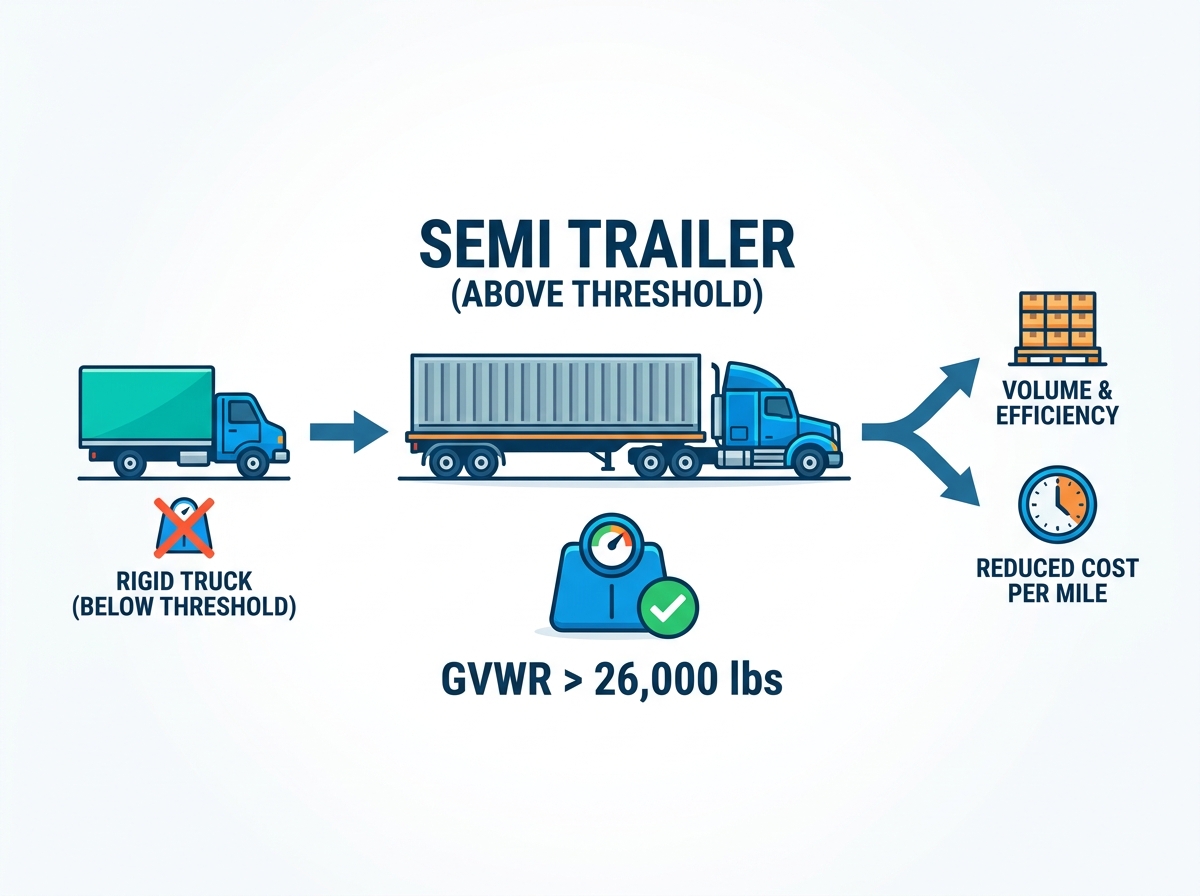
Volume vs. Weight: Standard cargo semi trailers are required when single-route volume exceeds 26,000 lbs GVWR, making rigid trucks economically unviable.
Application Diversity: Trailer selection must strictly align with cargo type—ranging from dry vans for retail freight to specialized lowboys for construction equipment.
Compliance Realities: Deploying a semi trailer introduces strict FMCSA oversight and mandatory DOT annual inspection protocols.
Procurement Strategy: Application duration (seasonal vs. permanent) dictates whether leasing or purchasing yields the highest ROI.
Every growing logistics operation hits a physical limit. A standard box truck works perfectly for local, low-volume deliveries. However, scaling routes eventually exposes the limitations of rigid frames. You must recognize exactly when an operational shift is necessary.
The Financial Threshold
The decision usually starts by analyzing your cost per mile. Dispatching three separate box trucks to deliver daily inventory drains resources. It triples your driver overhead. It multiplies your maintenance liabilities. It dramatically inflates fuel expenses. Consolidating these smaller loads into a single articulated route transforms your profit margins. You pay one driver instead of three. You maintain one power unit. The fuel efficiency of a single heavy-duty trip easily outperforms multiple smaller trips. Fleet operators must audit their current payload frequency. Frequent, overlapping box truck runs indicate an immediate need for an upgrade.
Payload & Volume Limits
Class 6 and Class 7 rigid trucks face strict physical constraints. They max out quickly regarding Gross Vehicle Weight Ratings (GVWR). When your daily operations consistently push these limits, safety risks multiply. Suspension wear accelerates rapidly. Braking distances become dangerously long. Heavy loads require the articulated weight distribution only larger setups can provide. By distributing cargo weight across tandem axles, articulated setups protect the road. They also protect your cargo and vehicle components. If your payload exceeds 26,000 lbs GVWR, standard trucks are no longer legally or safely viable.
Loading Dock Compatibility
Modern B2B fulfillment relies on standardized infrastructure. High-volume distribution centers use architectural designs matching 48-inch dock heights. Most rigid delivery trucks sit much lower. This height mismatch severely slows down forklift operations. It forces dock workers to use unsafe ramps or lift gates. Articulated fleets slide perfectly into standard commercial docks. This seamless compatibility allows rapid loading and unloading. For companies heavily involved in B2B supply chains, standardized dock heights make the upgrade absolutely mandatory.
Feature Comparison | Class 6/7 Rigid Box Truck | Heavy-Duty Articulated Unit |
|---|---|---|
Payload Capacity | Typically limits around 10,000 to 15,000 lbs cargo. | Can comfortably scale up to 45,000 lbs cargo. |
Dock Compatibility | Often requires lift gates; mismatched dock heights. | Perfectly aligns with standard 48-inch high B2B docks. |
Driver Overhead | High. Requires multiple drivers for large volume. | Low. One CDL driver moves triple the volume. |
Route Type | Ideal for last-mile and urban deliveries. | Ideal for regional linehaul and warehouse transfers. |
Matching the equipment to the job ensures maximum efficiency. Commercial freight demands vary wildly. Let us explore the core applications driving everyday logistics networks.
Application Scope: Retail replenishment relies heavily on massive volume movements. Fast-Moving Consumer Goods (FMCG) require rapid, bulk transportation from manufacturing plants to regional distribution hubs. Third-party logistics (3PL) providers build their entire linehaul operations around this standard freight. Moving electronics, dry foods, and clothing demands secure, high-capacity transport.
Trailer Fit: The standard 53-foot dry van dominates this sector. It provides maximum enclosed space. It protects goods from theft and weather conditions. These dry vans feature hardwood or aluminum floors designed for heavy forklift traffic.
Evaluation Lens: When evaluating this application, focus primarily on cubic capacity utilization. Weight is rarely the limiting factor for retail goods. Instead, operators typically "cube out" before they "weigh out." Weather protection remains a non-negotiable requirement. A standard Cargo Semi Trailer serves as the fundamental baseline for any non-perishable, palletized goods. It offers unmatched versatility for everyday commercial freight.
Best Practices for Dry Freight:
Always use load bars and securement straps to prevent pallet shifting.
Regularly inspect the roof for micro-tears to prevent water damage.
Optimize your pallet stacking patterns to maximize cubic volume.
Application Scope: Some goods require strict environmental control. Pharmaceuticals quickly degrade outside specific temperature ranges. Agricultural produce spoils rapidly during summer transits. Frozen foods demand sub-zero environments from the warehouse to the grocery store. This sector leaves no room for equipment failure.
Trailer Fit: Refrigerated units, commonly known as reefers, fit this application perfectly. They feature heavily insulated walls. They carry dedicated diesel power units to run continuous cooling cycles. Advanced reefers feature multi-temp zones, allowing you to transport frozen goods and chilled produce simultaneously.
Evaluation Lens: Evaluating reefers requires a strict focus on thermal integrity. The internal insulation degrades over time, reducing efficiency. Continuous power unit reliability is absolutely critical. A broken reefer unit can ruin a $100,000 payload in hours. Furthermore, operators must guarantee strict compliance with the FDA Food Safety Modernization Act (FSMA). The FSMA dictates sanitary transport rules, demanding rigorous cleaning logs and verifiable temperature tracking data.
Retail freight represents only one half of the logistics industry. Heavy industrial applications demand highly specialized equipment. Standard enclosed vans simply cannot handle these extreme payloads.
Application Scope: Construction firms constantly move massive assets. They transport heavy excavators, towering cranes, and massive bulldozers between job sites. Sometimes, they move pre-fabricated architectural structures like bridge beams or wind turbine blades. These items feature irregular dimensions and extreme weights.
Trailer Fit: Flatbeds serve as the entry point for industrial freight. However, taller equipment requires step-decks to lower the center of gravity. For extreme earth-moving machinery, removable gooseneck (RGN) lowboys are mandatory. RGNs allow the front of the bed to detach. This feature creates a ramp, letting operators drive heavy machinery directly onto the deck.
Evaluation Lens: Proper load distribution across multiple axles prevents road damage. Heavy haulers must carefully calculate axle weights to avoid massive fines. Clearance height remains a constant concern. Bridges and overpasses dictate strict height limits for oversized loads. Specialized coupling mechanisms must handle immense stress. Safety relies entirely on flawless load securement using heavy-duty chains and binders.
Common Mistakes in Heavy Haul:
Failing to scout the route for low overpasses before departure.
Underestimating the tension required for chain binders.
Ignoring state-specific bridge laws regarding axle weight distribution.
Application Scope: Modern industry relies on continuous fluid supply chains. Refineries transport industrial chemicals across the country. Farms require thousands of gallons of agricultural fertilizers. Energy sectors constantly move liquid natural gas (LNG) and petroleum fuels. These volatile payloads pose significant environmental risks.
Trailer Fit: Tanker variants handle all liquid bulk. Smooth-bore tankers transport food-grade liquids like milk. Specialized cryogenic carriers maintain extreme low temperatures for LNG. Corrosive chemicals require stainless steel or aluminum builds with internal protective coatings.
Evaluation Lens: Liquid cargo acts unpredictably in motion. Operators must evaluate tankers for internal baffling. Baffles act as bulkheads inside the tank. They mitigate liquid surge during hard braking. Without baffles, shifting liquid can easily flip the entire rig. You must also evaluate specialized discharge valves for leak-proof performance. Finally, stringent hazmat certification alignment is absolutely legally required. You cannot compromise on safety when transporting dangerous goods.
Purchasing heavy-duty transport equipment fundamentally changes your legal responsibilities. You cannot simply hand over the keys to an existing box truck driver. You must prepare for severe regulatory oversight.
FMCSA Regulatory Alignment
The Federal Motor Carrier Safety Administration (FMCSA) classifies and monitors all heavy commercial traffic. You must understand federal classifications thoroughly. Matching your specific trailer to your exact application represents a legal requirement. It is never just an operational preference. If you haul food products in a chemically contaminated unit, the FMCSA will shut down your operation. Regulatory alignment requires meticulous record-keeping and strict adherence to weight limits.
The DOT Inspection Burden
Heavy units require constant preventative maintenance. You must prepare for the reality of the Annual DOT Inspection. Frame this inspection as a necessary, predictable operational cost. DOT officers meticulously check brakes, lights, suspension components, and frame integrity. Applications involving harsh environments demand even higher maintenance reserves. Chemical transport corrodes lines. Heavy construction environments destroy tires and air bags. You must proactively replace wearing parts before the annual inspection catches them.
Driver Certification Impact
Acquiring larger units dramatically impacts your human resources department. Driving an articulated vehicle requires specialized training. It dictates an immediate shift to a CDL Class A driver workforce. Hiring CDL Class A drivers significantly impacts your payroll. These professionals command much higher salaries than standard delivery drivers. Furthermore, hiring timelines stretch much longer. You must run deep background checks, verify driving records, and administer strict drug testing protocols. Plan your hiring cycles months ahead of your equipment delivery.
Once you define the exact equipment required, you must decide how to acquire it. Capital allocation strategies determine the long-term success of your fleet upgrade. You must weigh upfront costs against operational longevity.
Predictable, Long-Term Applications
Purchasing makes the most sense when the application forms your core business model. Dedicated freight carriers, for example, run consistent routes daily. They rely entirely on asset availability. Buying outright allows you to leverage asset depreciation for tax advantages. You build equity in the equipment. When the unit reaches the end of its prime lifecycle, you can trade it in to recoup capital. Purchasing offers the lowest cost over an extended multi-year timeframe.
Seasonal or Pilot Applications
Not every operation runs year-round. Leasing represents the risk-mitigated choice for short-term spikes. Consider the agricultural harvest season. Farms need massive transport capacity for three months, then nothing. Buying equipment just to let it rust in a field destroys capital. Leasing allows you to return the unit when demand drops. Leasing also works perfectly when testing a new logistics route. If the new route fails, you simply return the equipment without absorbing a massive financial loss.
Shortlisting Next Steps
Before engaging a dealer or leasing agent, you must define your precise needs. Follow these critical steps:
Define your absolute maximum payload weight.
Calculate your necessary cubic volume for everyday runs.
Audit your specific delivery routes for height or weight restrictions.
Determine if your cargo requires temperature control or hazmat placarding.
Taking these steps ensures you procure the exact Semi Trailer your operation demands. Going to a dealer without this data often leads to buying mismatched, inefficient equipment.
Acquisition Strategy Matrix | Purchase Approach | Lease Approach |
|---|---|---|
Best Suited For | Permanent, daily linehaul operations. | Seasonal spikes, pilot routes, temporary contracts. |
Capital Requirement | High upfront cost or strict financing terms. | Lower upfront costs; predictable monthly expenses. |
Maintenance Burden | Fully owned by the operator. | Often included or shared under lease agreements. |
Risk Profile | High risk if route volume suddenly decreases. | Low risk. Easy to scale down operations quickly. |
The transition to heavy articulated transport marks a massive milestone for any logistics operation. The need for larger equipment is ultimately dictated by a mathematical intersection. You must constantly analyze payload volume, route frequency, and regulatory boundaries. When rigid trucks fail to meet volume demands efficiently, upgrading becomes the only logical step. Operators must proactively audit their current cost per pound delivered. This simple metric quickly justifies the transition.
To successfully execute this transition, remember these core takeaways:
Always match your trailer configuration precisely to your cargo type.
Budget proactively for CDL Class A driver payroll and DOT compliance maintenance.
Choose purchasing for permanent routes and leasing for seasonal volume spikes.
Do not let inadequate equipment strangle your business growth. Review manufacturer spec sheets today. Contact an experienced fleet consultant to match your exact application parameters with the perfect transport solution.
A: The primary difference lies in the coupling mechanism and weight distribution. A full trailer supports its entire weight on its own front and rear axles. Conversely, semi trailers rest their front weight directly on the tractor's fifth wheel. This design dramatically impacts maneuverability and allows the tractor to carry a significant portion of the payload weight safely.
A: Yes. While standard safety checks apply globally to all commercial vehicles, specialized units require deeper scrutiny. Standard dry vans face basic brake and structural checks. However, applications utilizing specialized equipment like chemical tankers or refrigerated reefers introduce additional regulatory checkpoints. Inspectors will mandate specific tests for pressure valves, thermal integrity, and sanitary compliance.
A: It depends strictly on the material and volume. Standard enclosed vans can legally carry very limited quantities of permitted hazmat, provided they display proper placards. However, dedicated bulk transport of dangerous liquids or gases requires specialized, compliant tankers. Using general freight equipment for bulk hazardous materials strictly violates federal law.
A: Your decision relies on capital availability, maintenance capacity, and application duration. If you operate predictable, year-round freight routes, purchasing leverages asset depreciation and builds equity. If you face seasonal harvest spikes or want to test unproven delivery routes, leasing mitigates financial risk and eliminates long-term maintenance burdens.