
Views: 187 Author: Site Editor Publish Time: 2026-03-21 Origin: Site


Cement trailers are essential vehicles for transporting bulk cement and other dry, powdered materials. Understanding the size of a cement trailer is crucial for businesses and logistics companies that rely on efficient transportation.
Cement trailers, often referred to as bulk cement carriers or cement tankers, play a significant role in the construction, mining, and infrastructure industries. These trailers are specifically designed to transport dry bulk materials like cement, lime powder, and other similar substances. Given their large-scale cargo capacity, understanding the size of a cement trailer is essential for businesses involved in cement production, distribution, and logistics.
In this article, we will delve into the typical dimensions of cement trailers, how their size influences capacity, and the factors that determine the right size for various transportation needs. This guide will help you gain a clearer understanding of cement trailer sizing and assist in making informed decisions about your transportation needs.
A cement trailer is a type of semi-trailer used for transporting dry bulk materials, most commonly cement. These trailers are equipped with a cylindrical tank that holds the material and is designed for high-efficiency loading and unloading.
The primary purpose of a cement trailer is to carry bulk materials from one location to another, often from production plants to construction sites or bulk distributors. Cement trailers are an essential part of the supply chain for building materials, especially in large-scale construction projects.
Standard Cement Trailers – These trailers are built to transport cement or similar powdered materials with a basic cylindrical design.
Custom Cement Trailers – Custom-designed trailers are used when there is a need to transport specific materials or meet particular regulatory requirements. Custom sizes are often necessary for large-scale projects.
LNG Cement Trailers – Some cement trailers are designed for liquefied natural gas (LNG) as a fuel for the cement industry.
Tanker Cement Trailers – These trailers come with additional tank systems to ensure more efficient unloading through pneumatic systems.
Understanding the standard dimensions of a cement trailer is essential for businesses that need to ensure efficient cargo transportation while adhering to legal weight and size regulations.
Length: Cement trailers generally range from 40 feet to 45 feet. The length of the trailer largely depends on the cargo and the required capacity.
Width: The typical width of a cement trailer is around 8.5 feet, adhering to most national highway standards.
Height: The height is generally 12 to 13.5 feet, but some may be slightly taller depending on their design and the types of materials they are intended to carry.
Dimension | Typical Size | Range |
Length | 40 - 45 feet | 36 - 50 feet |
Width | 8.5 feet | 8.2 - 8.6 feet |
Height | 12 - 13.5 feet | 11 - 14 feet |
There are international guidelines that limit the dimensions of trailers to ensure they fit within road regulations and bridge heights. For example, in the United States, the Federal Highway Administration sets the maximum permissible length for a tractor-trailer combination to be 53 feet, including both the tractor and trailer. In Europe, trailers are usually restricted to 16.5 meters (approximately 54 feet), depending on the road regulations.
The size of a cement trailer significantly impacts its overall capacity. The capacity is usually measured by weight (tons) and volume (cubic meters). Knowing the capacity of a cement trailer helps businesses plan for transportation logistics and ensures that their trailers can handle the intended load.
Cement trailers are typically designed to carry weights ranging from 20 to 30 tons of cement. The weight depends on the material used for construction and the specific design of the trailer.
Cement trailers generally have a volume capacity ranging from 30 to 45 cubic meters. This depends on the type of material and the internal design of the trailer.
Capacity Type | Typical Range | Notes |
Weight | 20 - 30 tons | Depending on the trailer type and material used. |
Volume | 30 - 45 cubic meters | Larger trailers hold more volume, crucial for large shipments. |
Larger cement trailers with bigger tank volumes will be able to carry more material, which helps in reducing transportation costs and time. The size of the trailer and its load capacity must align with the requirements of the cement supply chain.
Several factors contribute to the variation in the size of cement trailers, beyond the typical industry standards.
Different countries have distinct regulations concerning trailer size, particularly related to road safety and infrastructure limitations. These regulations can impose strict limits on trailer length, width, and height to prevent accidents and ensure smooth transport on national highways.
The type of material being transported affects the size of the trailer. Cement is a heavy material that requires strong and durable trailers, but trailers designed for other bulk materials may vary in size. Additionally, the weight distribution within the trailer can affect the design and overall size.
Cement trailers can be customized in size to meet specific transportation requirements. For example, some trailers are designed to handle larger quantities of materials or unique unloading systems that require special adaptations in size and capacity.
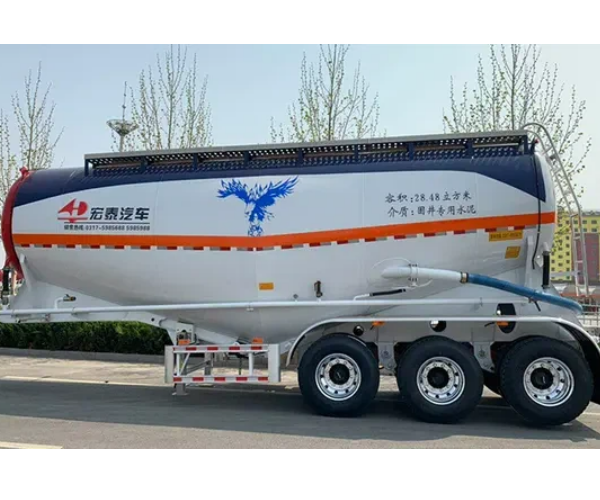
The most common bulk cement trailers are typically 40 feet or 45 feet in length, depending on local regulations and transportation needs. In Europe and Asia, cement trailers may vary slightly in size, but the capacity remains similar to those used in North America.
40-foot Cement Trailers: These are commonly used for shorter-distance transportation where space and road restrictions are more stringent.
45-foot Cement Trailers: Ideal for long-distance transportation of larger quantities of cement or other powdered materials.
Cement trailers may also be designed differently based on their length. For instance, a 40-foot trailer is typically designed for higher maneuverability and tighter road conditions, whereas a 45-foot trailer offers more cargo space for bulk operations.
While there are standard sizes available, many cement trailers are customizable based on business or regional needs.
Custom sizes are necessary when specific factors such as material type, transport distance, and regional regulations demand a unique trailer design. For example, trailers designed for large construction sites or industrial operations may have more robust features, larger tank volumes, or more sophisticated unloading systems.
Pneumatic Unloading System: Custom trailers often come with advanced unloading systems to make unloading cement quicker and more efficient.
Material Adaptations: Some trailers are designed with specialized materials for handling different types of cement or other bulk materials.
Optimizing the size of a cement trailer can lead to significant cost savings and efficiency improvements in the logistics chain.
Larger trailers allow companies to carry more cargo per trip, reducing the number of trips required and cutting down on fuel consumption. This directly lowers transportation costs.
By optimizing trailer size according to local regulations, companies can avoid fines and ensure they are operating within the bounds of road safety standards.
Trailer size optimization also allows for better load management, reducing the chances of overloading or underloading, which can affect transportation costs and time.
The size of a cement trailer is crucial in maximizing the efficiency and effectiveness of cement transportation. Understanding the standard and custom sizes, along with their relation to capacity, regulatory constraints, and operational needs, allows businesses to make informed decisions. By optimizing trailer size for fuel efficiency, load volume, and cost savings, companies can streamline their transportation operations and significantly reduce overall costs.
At China Hongtai International Vehicles Co., Ltd., we specialize in providing high-quality cement trailers tailored to meet various industry needs. Our team offers expert guidance on selecting the right trailer size based on your specific transportation requirements. Whether you need standard or custom designs, we ensure our trailers are built for efficiency, durability, and compliance with regulatory standards.
For more information or to discuss your cement transportation needs, feel free to reach out to us. We are here to help optimize your logistics operations and ensure you get the best solution for your business.
The average size of a cement trailer is typically 40 to 45 feet in length, with a width of 8.5 feet and a height of about 12 to 13.5 feet.
The size of a cement trailer directly influences its capacity in terms of both weight (up to 30 tons) and volume (30-45 cubic meters). Larger trailers are designed to carry more material, making them more efficient for long-haul transportation.
Yes, various countries impose restrictions on the maximum size of trailers based on road safety regulations. These regulations ensure that trailers fit within the design of roads, bridges, and tunnels.
Yes, cement trailers can be customized to meet specific needs. Customization may involve larger capacities, specialized unloading systems, or adapting to local road restrictions.
A typical cement trailer has a weight capacity ranging from 20 to 30 tons, depending on the material used in construction and the design of the trailer.


