Views: 126 Author: Site Editor Publish Time: 2026-07-08 Origin: Site
For fleet managers and owner-operators, durability is not a marketing buzzword. It serves as the primary driver of long-term profitability and operational efficiency. Premature wear leads directly to unpredictable downtime. It also compromises road safety for everyone. You cannot afford equipment failing during critical transit windows.
Evaluating a trailer requires looking past surface-level specifications. You must understand the structural, mechanical, and environmental variables dictating long-term performance. A shiny exterior often hides subpar welding or weak cross-members. True evaluation demands a rigorous look at how materials respond to daily abuse.
This guide deconstructs the key factors determining equipment longevity. We provide buyers with an evidence-based framework. You will learn how to assess structural integrity, component reliability, and lifecycle value. Use these insights to make a highly informed purchasing decision.
A truly durable semi trailer balances payload capacity with structural resilience, primarily dictated by frame material (high-tensile steel vs. aluminum) and welding quality.
High-stress components—such as suspensions, axles, and flooring—require stringent evaluation, as they are the most common points of failure in commercial fleets.
Anti-corrosion treatments (like galvanization) are non-negotiable for trailers operating in regions with harsh winter climates or road salt exposure.
Maintenance serviceability directly impacts durability; a trailer designed for accessible repairs will outlast one with a proprietary, hard-to-reach architecture.
The true cost of equipment failure extends far beyond a simple repair bill. A cheap trailer featuring poor structural integrity frequently triggers massive financial drains. Forced out-of-service (OOS) events stall your supply chain. Load rejections occur when damaged floors compromise freight safety. Expedited maintenance costs consume your operational budget rapidly. When a unit sits in the shop, it generates zero revenue. It only drains resources. Buying cheap upfront usually guarantees expensive operational realities later.
Lifecycle valuation offers a better metric for procurement. Durability correlates directly with end-of-life resale value. A well-documented maintenance history on a structurally sound unit retains significant capital. Fleet buyers actively seek used equipment demonstrating strong residual integrity. A premium initial investment often yields higher returns upon disposal. You recapture a large portion of your capital when the frame remains uncompromised.
We must define the standard for success. An optimal purchase balances upfront acquisition costs against the projected lifespan. You want to maximize payload capacity. You also need to minimize preventative maintenance intervals. Finding this equilibrium requires a deep understanding of engineering. A truly Durable Semi Trailer actively resists structural fatigue while keeping maintenance predictable and manageable.
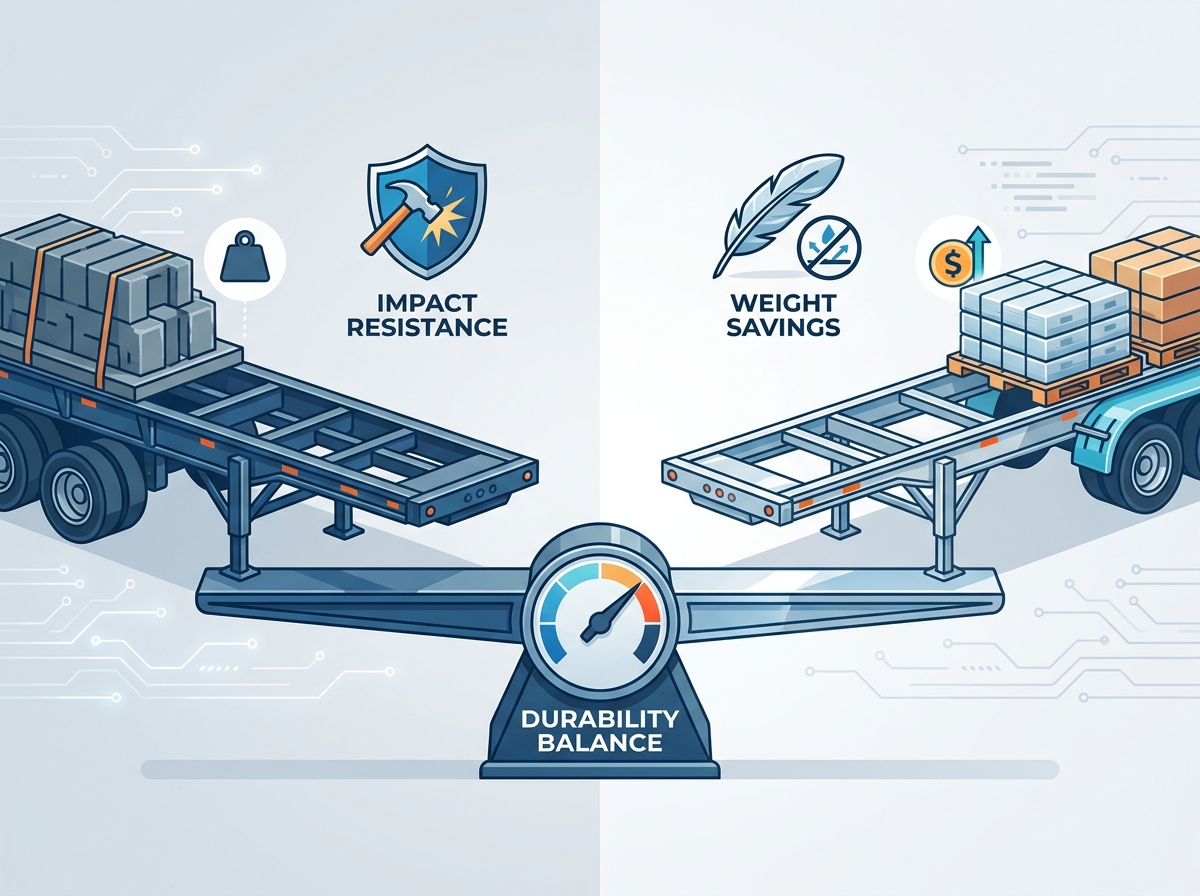
Material selection defines the operational boundaries of your equipment. High-tensile steel offers incredible yield strength. Engineers often utilize steel rated between 80,000 and 100,000 PSI. This delivers exceptional impact resistance. Steel remains highly suitable for heavy-haul operations enduring severe twisting forces. Conversely, aluminum alloys provide significant weight savings. Aluminum naturally resists surface corrosion. It allows fleets to haul heavier payloads legally. However, aluminum remains vulnerable to stress fractures under extreme dynamic loads.
Cross-member spacing plays a critical role in floor strength. Tighter spacing yields significantly higher floor capacities. It reduces deck flex under dynamic loading conditions. A 12-inch spacing outperforms a 15-inch spacing when heavy forklifts load cargo. Less flex means fewer broken welds over time.
Material Trade-off Analysis | |||
Material Type | Primary Advantage | Primary Weakness | Best Use Case |
|---|---|---|---|
High-Tensile Steel | Superior impact resistance and yield strength. | Heavier weight reduces maximum legal payload. | Heavy-haul, machinery transport, severe road conditions. |
Aluminum Alloy | Maximizes payload capacity; resists rust naturally. | Prone to stress fractures under torsional twist. | Long-haul dry freight, weight-sensitive liquid transport. |
Composite / Hybrid | Balances weight savings and structural strength. | Higher initial acquisition cost. | Mixed-use fleets requiring versatility. |
Inconsistent welds act as ticking time bombs. Automated robotic welding consistently outperforms manual welding. Robots deliver precise heat control. They ensure deep, uniform penetration along the entire beam. Manual welding introduces human error. Operator fatigue leads to porous joints and weak connections. These flaws remain hidden under fresh paint until they fail catastrophically on the highway.
You must rigorously assess the integration of primary stress zones. The main beams, kingpin plate, and rear impact guards endure massive kinetic energy. Stress concentrations in these areas dictate the maximum operational life of the unit. A poorly integrated kingpin plate will crack under the relentless pushing and pulling of the tractor. High-quality manufacturers reinforce these specific zones heavily. They use continuous welding techniques to distribute stress evenly across the chassis.
Suspension systems dictate how much road violence reaches the frame. Air ride suspensions absorb kinetic energy exceptionally well. They reduce road shock transfer to the main chassis. This isolation extends the overall lifespan of the metal structure. Spring suspensions cost less initially. Yet, they transmit harsh vibrations directly into the cross-members. This constant battering accelerates metal fatigue.
Tire quality provides a visible window into structural health. Premium tires withstand long miles. However, uneven tire wear serves as a vital diagnostic tool. Scuffing or rapid shoulder wear often indicates underlying frame misalignment. It can also point to bent axles. If you spot aggressive tire degradation early, you can often correct suspension geometries before permanent chassis damage occurs.
Flooring faces brutal daily punishment. Forklift traffic creates immense localized pressure. You must evaluate wood versus aluminum floors carefully. Hardwood floors, particularly oak, handle heavy point loads excellently. They distribute weight effectively across the cross-members. Aluminum floors save weight and clean easily. However, they dent and deform under aggressive forklift maneuvering.
Implementation realities matter deeply. A floor weight rating must match your specific operational reality. You need to calculate the forklift axle weight. Do not rely solely on the static cargo weight. A 10,000-pound cargo pallet resting quietly causes little stress. A 10,000-pound forklift bouncing across the threshold destroys weak decking instantly.
Identify Forklift Specs: Determine the maximum front-axle weight of your heaviest loading equipment.
Verify Floor Ratings: Ensure the manufacturer’s floor rating exceeds this dynamic load weight by at least 20%.
Inspect Threshold Plates: Check the rear loading threshold. It requires steel reinforcement to survive dock plate impacts.
Assess Fastener Density: Count the floor screws per board. Higher density prevents board shifting and moisture intrusion.
Rust operates as the silent killer of any commercial fleet. You must evaluate anti-corrosion treatments thoroughly. Hot-dip galvanization provides the ultimate defense mechanism. The process completely submerges steel components in molten zinc. This creates a metallurgical bond preventing rust permanently. Standard polyurethane paint looks beautiful initially. However, road debris chips the paint quickly. Moisture penetrates these chips, rusting the steel from the inside out. Standard undercoating requires frequent reapplications to remain effective.
Electrical and pneumatic systems require equal protection. You must assess the routing of air lines. You must inspect the electrical harnesses closely. Manufacturers should seal these systems completely. They must route them inside the main frame rails. Exposure to flying road debris causes microscopic abrasions. Chemical de-icers, particularly magnesium chloride, eat through cheap wiring insulation rapidly. A durable Semi Trailer protects its nervous system rigorously.
Summary Chart: Coating Effectiveness vs. Winter Conditions | |||
Coating Method | Durability Rating | Resistance to De-icers | Maintenance Needs |
|---|---|---|---|
Hot-Dip Galvanization | Excellent (15+ Years) | High | Virtually None |
Two-Part Epoxy Primer + Paint | Good (5-8 Years) | Moderate | Periodic touch-ups required for rock chips. |
Standard Polyurethane | Fair (3-5 Years) | Low | High. Rapid degradation in salt environments. |
Federal weight limits shape structural longevity. The Federal Highway Administration (FHWA) provides strict guidelines regarding legal axle weights. Consistently maxing out these limits accelerates metal fatigue dramatically. Improper weight distribution creates concentrated stress zones. Placing 40,000 pounds directly in the center of a 53-foot deck forces the main beams to bow. Over time, this repetitive bowing creates micro-fractures in the lower flanges.
You must apply strict evaluation criteria regarding payload buffers. Does the gross vehicle weight rating (GVWR) provide a safe margin for your average operational loads? Purchasing equipment rated precisely for your maximum load leaves no room for error. Specifying a slightly higher GVWR ensures the structural components never operate at their absolute breaking point. This strategic over-specifying adds years to the chassis lifecycle.
A truly resilient asset prioritizes serviceability from the blueprint stage. Mechanics evaluate designs based on accessibility. You must evaluate access to suspension grease points. You need to determine the ease of brake shoe replacements. Can a technician reach the Slack Adjusters without removing specialized panels? Simple maintenance tasks should never require extensive teardowns. When maintenance is difficult, technicians often skip it.
Risk mitigation requires standardized engineering. Relying on rare OEM-specific parts increases downtime exponentially. Standardized, high-quality aftermarket components improve long-term viability. If a wheel seal fails in a remote location, your driver needs to find a replacement at any local truck stop.
Best Practice: Standardize wheel ends and brake components across your entire fleet.
Best Practice: Route wiring externally along accessible tracks rather than feeding it blindly through structural tubes.
Common Mistake: Purchasing proprietary axle designs. This locks you into expensive dealership service networks.
Common Mistake: Ignoring the placement of gladhands. They should be recessed to prevent damage during tight tractor turns.
You must read warranties critically. Manufacturers use clever language to limit liability. You need to distinguish between full structural warranties and limited component warranties. A "10-year warranty" might only cover the main beams. It might explicitly exclude cross-members, kingpin plates, and paint finish. Read the exclusions carefully. They reveal where the manufacturer expects failures to occur.
Take proactive next steps before signing purchase orders. Request engineering stress-test data from the vendor. Review the manufacturer's quality assurance (QA) checklists. Conduct a thorough physical inspection of a completed unit. If you lack mechanical expertise, hire a third-party assessment firm. Verify the depth of the welds and the thickness of the frame webbing. Trust requires verification.
Semi trailer durability is not a single, isolated feature. It represents the sum of informed engineering, rigorous material science, and intelligent operational alignment. When you align high-tensile steel construction, heavy-duty suspension choices, and robust anti-corrosion treatments, you create an asset capable of surviving brutal highway environments.
Buyers should consistently prioritize long-term value over the initial sticker price. Shortlist manufacturers offering transparent material sourcing. Demand robust galvanization measures. Verify proven structural integrity through independent testing. Paying a slight premium today prevents massive operational headaches tomorrow.
Take action immediately. Review your current fleet maintenance logs. Identify your most common failure points. Do your cross-members crack? Do your floors fail under forklift pressure? Once you map these vulnerabilities, consult an expert manufacturer. Spec a unit engineered explicitly to resolve those historical weaknesses.
A: Typically, they last 10 to 15 years. However, this lifespan varies wildly. Mileage, maintenance schedules, load types, and environmental exposure dictate actual longevity. A well-maintained unit operating in dry climates can exceed 20 years. Conversely, units hauling heavy loads through corrosive winter salts may require major structural overhauls within seven years.
A: Aluminum resists surface corrosion naturally and maximizes payload via significant weight reduction. However, high-tensile steel offers superior impact resistance. Steel handles heavy dynamic stress better. It is also significantly easier to repair and weld if damaged. Aluminum tends to suffer from stress fractures under severe twisting loads.
A: Air suspensions absorb kinetic energy from uneven roads efficiently. They prevent micro-fractures in the mainframe. They also protect sensitive cargo. By isolating the chassis from harsh impacts, air ride systems dramatically extend the overall lifecycle of the equipment compared to rigid spring suspensions.
A: Look closely for cracked welds around the kingpin plate and suspension hangers. Watch for sagging cross-members beneath the floor decking. Uneven tire wear often signals bent axles or frame misalignment. Additionally, pervasive rust penetration on the main beams indicates severe degradation requiring immediate inspection.