
Views: 148 Author: Site Editor Publish Time: 2026-06-30 Origin: Site


Selecting the ideal materials for a commercial fleet demands intense strategic planning from operators today. It directly dictates your ultimate bottom line. Choosing the wrong material restricts maximum payload capacity. It drastically inflates lifetime maintenance needs and slashes the vehicle's residual trade-in value. Fleet managers face a constant balancing act on the road. You must weigh vital tare weight reductions against pure structural durability. Your specific freight types and daily route conditions heavily influence this critical choice. This guide provides an objective, evidence-based breakdown of primary manufacturing materials. We thoroughly examine the specific metals and composites used in modern production facilities. You will learn how to optimize legal payloads, navigate harsh environments, and confidently guide your next major procurement decisions.
Material selection directly impacts ROI: Every pound saved in trailer tare weight equates to a potential pound of billable payload.
Steel dominates heavy-haul: A steel semi trailer remains the industry standard for extreme load-bearing applications and rugged environments, despite its heavier tare weight.
Aluminum offers long-term savings: While upfront costs are higher, aluminum trailers resist corrosion and offer superior residual value.
Hybrids bridge the gap: "Combo" trailers (steel frames with aluminum components) offer a strategic middle ground for fleets needing both structural rigidity and weight reduction.
Every procurement decision begins by evaluating fundamental fleet economics. You must understand the inverse relationship between tare weight and maximum legal payload. Federal gross vehicle weight (GVW) limits strictly cap commercial trucks at 80,000 pounds across most interstate highways. If your empty truck and trailer weigh 35,000 pounds, you can legally haul 45,000 pounds of freight. If you trim 2,000 pounds off the equipment, you instantly gain 2,000 pounds of billable payload capacity. Over hundreds of trips annually, this extra capacity scales revenue exponentially. Choosing the right Semi Trailer directly controls these financial margins.
Metals react aggressively to environmental hazards. Winter road treatments create massive liabilities for fleet lifespans. Standard rock salt initiates fast oxidation on unprotected surfaces. Modern de-icing chemicals, such as liquid magnesium chloride, pose an even greater threat. They cling stubbornly to undercarriages and accelerate metal degradation. We constantly see fleets lose years of aesthetic and structural life because they fail to match their equipment materials to their regional climates. A rig running exclusively in dry southwestern states faces entirely different environmental pressures than one navigating harsh midwestern winters.
Fleet maintenance realities dictate operational uptime. Equipment breaks down, and remote repairs become necessary. Standard arc welding fixes most heavy-duty equipment. Virtually every commercial diesel shop or mobile mechanic across the country carries the equipment needed to patch conventional metals. However, specialized materials require specialized tools. If a lightweight rig cracks a structural cross-member in a remote rural area, finding a technician certified in TIG or MIG welding becomes a logistical nightmare. You must factor your primary operating regions into your material decisions to avoid costly downtime.
Industry veterans recognize high-tensile steel as the undisputed heavyweight champion of commercial freight. Its core characteristics make it indispensable for demanding jobs. Steel offers exceptional tensile strength and superior flexibility under extreme stress. It bends and flexes before it permanently deforms or breaks. This impact resistance absorbs the violent shocks generated by rough loading processes and unpaved roads.
The practical implementation of a standard Steel Semi Trailer brings specific advantages and distinct risks.
Pros: You benefit from a significantly lower initial acquisition cost. It frees up upfront capital for other fleet investments. Steel remains highly durable for construction materials, heavy equipment hauling, and rough terrain navigation. Furthermore, nearly any commercial shop can perform emergency structural repairs quickly and affordably.
Risks: You must manage its high susceptibility to rust and rapid corrosion. Bare steel degrades quickly when exposed to moisture and road salts.
To mitigate these lifecycle degradation risks, manufacturers employ advanced protective measures. Hot-dip galvanization immerses the entire frame into molten zinc, creating a powerful rust-proof barrier. Alternatively, advanced powder-coating techniques bake a durable polymer shell onto the metal. You must specify these treatments if you operate in wet or snowy regions.
Heavy-haul flatbeds, oversized lowboys, intermodal chassis, and severe logging applications rely almost entirely on this robust material. In these specific sectors, catastrophic structural failure presents a far higher risk than minor payload optimization. When hauling a 60,000-pound bulldozer, you need absolute structural certainty.
Best Practice: Always request hot-dip galvanization for equipment operating in the rust belt or coastal areas.
Common Mistake: Ignoring deep paint scratches. Moisture penetrates compromised powder-coating and causes "rust jacking," where expanding rust physically pushes the paint off the frame.
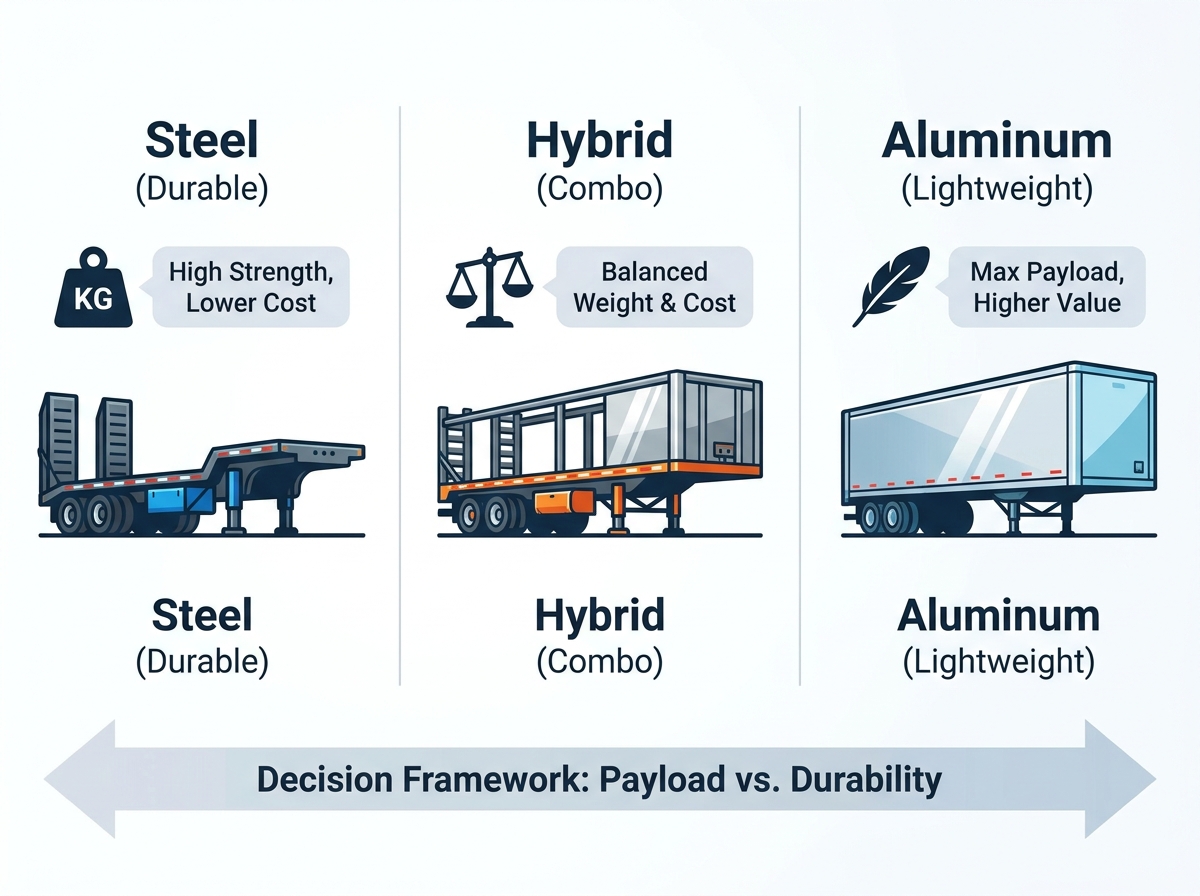
Modern logistics frequently prioritize weight reduction to maximize profitability. Aluminum serves as the premier choice for weight-conscious fleets. Its core characteristics completely change payload dynamics. It is remarkably lightweight. It routinely saves 1,000 to 2,000 pounds compared to standard equivalents. Additionally, it is naturally rust-resistant. It generates a protective oxide layer when exposed to air, stopping environmental degradation in its tracks.
Upgrading to lightweight alloys changes how you operate and maintain your fleet.
Pros: You maximize your billable freight on every single run. This proves exceptionally lucrative for high-density loads like bottled beverages or paper rolls. The excellent corrosion resistance leads to a much longer aesthetic life. Equipment looks cleaner for years, which drastically improves your corporate image. Consequently, it commands a much higher resale and trade-in value on the secondary market.
Risks: You face a noticeably higher initial purchase price. These units often cost 15% to 20% more upfront. The material is also more rigid. It proves prone to stress fractures under concentrated, heavy impacts. Finally, structural repairs require specialized TIG/MIG welding, which costs more and limits your repair shop options on the road.
This material dominates specific hauling sectors. Dry vans, refrigerated units (reefers), and livestock haulers benefit immensely. In these industries, maximizing internal volume and legal weight limits directly scales daily revenue. When you haul temperature-controlled produce across the country, saving 1,500 pounds on the equipment translates into substantial annual profit increases.
Many fleets operate in varied environments handling diverse freight. They cannot commit fully to extreme weight savings or massive structural weight. Manufacturers developed combo and composite models to solve this operational dilemma. Their core characteristic relies on the strategic integration of different materials.
Engineers typically design a robust main frame and primary cross members from high-tensile metals. They then combine this heavy-duty spine with lightweight decks, side rails, and roof structures.
This hybrid approach requires careful engineering and maintenance.
Pros: It perfectly balances lower costs and high strength with meaningful weight savings. You get a durable spine capable of handling forklift loading, paired with a lighter overall footprint.
Risks: You must actively monitor for galvanic corrosion. This destructive chemical reaction occurs when dissimilar metals physically touch in the presence of an electrolyte (like saltwater). Electrons transfer between the metals, causing rapid deterioration of the weaker material.
To prevent galvanic corrosion, manufacturers implement strict engineering requirements. They insert dielectric separators wherever the two distinct materials meet. They frequently use heavy-duty mylar tape or specialized polymer pads to isolate the components physically.
Modern manufacturing also heavily utilizes advanced composites. Fiberglass Reinforced Plywood (FRP) and synthetic composite panels dominate modern dry van sidewalls. Fleet owners value them for their incredibly smooth, snag-free interiors. They eliminate the need for interior plywood liners. They also provide outstanding durability against clumsy forklift damage during rapid loading. While they weigh slightly more than ultra-thin sheet alloys, their sheer resilience makes them highly popular for less-than-truckload (LTL) operations.
Material Type | Primary Advantage | Ideal Freight Type | Corrosion Resistance | Upfront Cost |
|---|---|---|---|---|
Traditional Baseline | Maximum structural strength | Heavy machinery, construction | Low (Requires galvanization) | Lowest |
Lightweight Alloy | Maximum payload capacity | High-density goods, refrigerated | High (Naturally resistant) | Highest |
Combo / Hybrid | Balanced strength to weight | Mixed freight, flatbed lumber | Moderate (Watch galvanic joints) | Medium |
FRP / Composites | Snag-free, impact resistant | LTL, palletized dry goods | High (Non-metallic walls) | Medium-High |
Procuring new equipment requires a rigid, objective evaluation process. You must analyze your unique operational envelope before committing capital.
Smart buyers always look far beyond the initial sticker price. You must calculate the broader lifecycle economics of the equipment. A simple equation helps clarify this strategy. Combine your initial purchase price with projected maintenance and painting costs over a ten-year span. Subtract your estimated fuel penalties or add your projected payload revenue gains. Finally, factor in the expected resale value. Lightweight equipment costs more today but frequently returns a massive premium when you trade it in a decade later.
Your specific freight profile serves as the ultimate deciding factor.
Weigh-Out Freight: If your fleet hauls dense commodities like beverages, paper rolls, or bulk liquids, you "weigh out." You hit the 80,000-pound legal limit long before you run out of physical floor space. In this scenario, lightweight equipment is highly profitable. The extra cost pays for itself quickly through increased cargo billing.
Cube-Out Freight: If your fleet hauls light, bulky items like potato chips, insulation, or empty plastic bottles, you "cube out." You fill every cubic inch of the box but remain thousands of pounds under the legal weight limit. If you cube out, paying a massive premium for ultra-lightweight metals will never yield a positive return on investment.
You must carefully assess your regional infrastructure. Rough, unpaved logging roads or oilfield access routes heavily favor rugged traditional materials. Rigid lightweight frames will crack under constant twisting forces. Conversely, if your routes stay strictly on paved interstates but traverse heavy winter weather, road salt becomes your primary enemy. In heavily salted regions, lightweight alloys or meticulously hot-dip galvanized metals become mandatory to prevent the equipment from rotting away prematurely.
There is no universal "best" material in commercial transportation. There is only the correct specification for your highly specific operational envelope. You must balance upfront costs against long-term payload potential and environmental durability. Weighing out versus cubing out determines your immediate revenue. Regional weather patterns and maintenance accessibility dictate your ongoing expenses.
Before issuing your next Request for Proposal (RFP), we strongly recommend shortlisting your next steps. Conduct a rigorous internal fleet audit on your current maintenance logs. Check exactly how much capital you spend annually on rust mitigation. Compare that figure against revenue lost to payload turn-aways due to excessive vehicle weight.
Take direct action today. Gather your load density data and route maps. Consult closely with a commercial trailer specialist to run a comprehensive lifecycle cost analysis entirely tailored to your specific routes and distinct freight profiles. Making an evidence-based decision today secures your operational profitability for the next decade.
A: Weight savings vary based on specific dimensions and configurations. Typically, lightweight alloy models save between 1,000 and 2,500 pounds compared to their traditional counterparts. A standard 48-foot flatbed sees roughly a 1,500-pound reduction, immediately increasing your maximum legal cargo capacity by that exact amount.
A: Hot-dip galvanization provides exceptional rust protection, but it is not entirely invincible. Raw metal rusts rapidly. Painted surfaces delay rust until the paint scratches. Galvanization chemically bonds a thick zinc layer to the base frame. This layer acts as a sacrificial barrier, taking decades to wear down before the underlying frame can rust.
A: Galvanic corrosion is an electrochemical process. It happens when two different metals, like steel and aluminum, physically touch in the presence of an electrolyte like salty road water. Electrons migrate from the softer metal, causing rapid localized deterioration. Modern manufacturers prevent this by installing dielectric separators and mylar tape between the joints.
A: Yes, they generally hold superior residual values on the secondary market. Because they naturally resist rust, they avoid the severe cosmetic and structural degradation that plagues older traditional fleets. Assuming no major structural frame damage exists, buyers gladly pay a premium for used equipment that requires zero rust remediation.


