
English 
Views: 0 Author: Site Editor Publish Time: 2026-10-20 Origin: Site


Choosing the wrong semi trailer can increase costs and create serious transport risks. Heavy cargo demands careful planning, not guesswork. How do you choose the right trailer for your needs? This guide covers trailer types, load capacity, axle configuration, safety features, and operating costs to help you make an informed decision.
Start by identifying the material or equipment you need to transport. Construction machinery, steel beams, cement, and liquid products require different trailer designs. Their weight distribution, loading methods, and securing needs can vary significantly. For example, excavators often need a low loading deck and suitable ramps. Long steel sections may require an open platform and properly positioned tie-down points. Dry cement requires a sealed bulk tank rather than a conventional flatbed.
Next, consider how often the cargo moves and where loading takes place. Regular routes may support a standardized trailer configuration. Mixed cargo operations may require greater flexibility. Buyers should also check whether forklifts, cranes, or self-propelled equipment will handle loading. These details help determine the trailer structure before technical specifications are compared.
Record the cargo's actual weight, length, width, height, and center of gravity. Include packaging, supports, and securing equipment when calculating the total load. These details affect payload requirements, deck dimensions, stability, and legal compliance. A trailer may offer enough nominal payload but still prove unsuitable for a long or unusually concentrated load.
Load distribution matters as much as total weight. Excessive loading on one axle group can exceed legal limits even when the overall combination remains below its gross weight limit. Buyers should evaluate cargo placement alongside tractor specifications and trailer axle ratings. For oversized loads, measure the complete transport height and width, including the trailer and securing equipment.
Tip: Before requesting quotations, prepare a cargo specification sheet containing weight, dimensions, center of gravity, loading method, and destination.
Trailer structure should match the cargo's physical properties and handling requirements. Flatbed trailers provide open access for many industrial products. Lowbed trailers reduce loading height for heavy machinery. Extendable platforms accommodate certain long loads, while specialized trailers support specific materials or transport tasks. Each option offers different advantages and limitations.
Buyers can review the manufacturer's semi trailer product range to identify suitable designs. However, product categories alone cannot confirm whether a particular model meets the intended load requirements. Confirm deck strength, usable dimensions, axle configuration, and loading arrangements with the manufacturer before making a decision.
Payload capacity refers to the cargo weight a trailer can carry under its applicable operating limits. It differs from gross vehicle or combination weight, which includes vehicle tare weights and other components. Buyers must check the trailer's rated capacity, the tractor's limits, axle ratings, and the regulations governing the intended route.
The heaviest available configuration is not automatically the best choice. Additional axles may improve load distribution, but they can also affect maneuverability, tire costs, and maintenance. The correct setup depends on the actual load, axle spacing, road conditions, and permitted axle loads. Obtain engineering guidance when cargo weight is concentrated over a small contact area.
Loading height affects both loading safety and transport clearance. A lowbed semi trailer can help accommodate tall machinery by reducing the deck height. This may reduce the overall transport height and simplify route planning. However, buyers must also consider approach angles, ramp length, machine ground clearance, and clearance beneath the trailer.
Measure the loaded combination rather than relying only on the trailer's empty dimensions. Suspension movement, cargo height, and securing equipment can affect the final measurements. Bridges, tunnels, overhead cables, and site entrances may impose additional restrictions.
Some heavy loads require specialized equipment. Detachable goosenecks can assist certain machinery-loading operations. Hydraulic ramps may simplify equipment loading, while extendable decks can support longer cargo. Reinforced platforms and additional securing points may also be necessary for particular load arrangements.
These features should be selected according to the cargo and operating conditions. They add weight, cost, and maintenance requirements, so unnecessary options may reduce efficiency. Oversized or overweight cargo may also require permits, route surveys, escort vehicles, or restricted travel times. Confirm these requirements before finalizing the trailer specification.
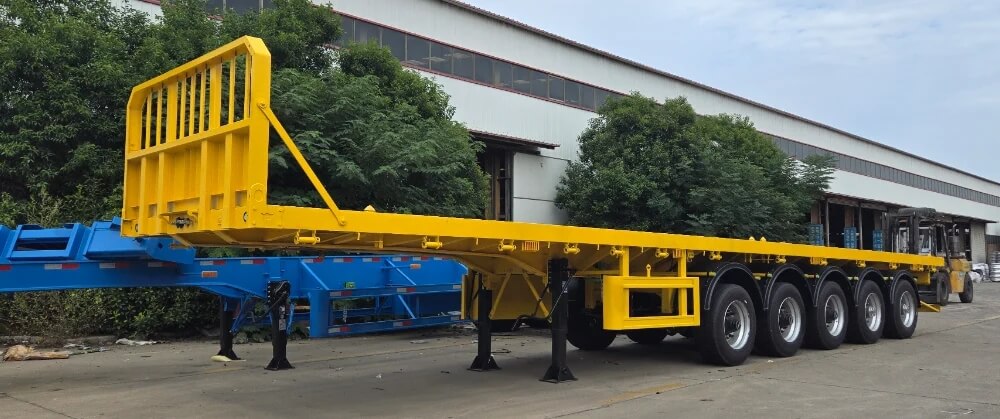
Flatbed semi trailers suit steel sections, timber, machinery components, and many packaged industrial materials. Their open decks allow loading from different sides, depending on site access and equipment. This flexibility can reduce handling difficulties when cargo dimensions vary between shipments. Buyers should assess deck length, width, floor construction, tie-down points, and load distribution.
For example, a 5 Axles Flatbed Trailer may be worth evaluating for applications requiring a multi-axle platform. Its suitability depends on the cargo weight, axle ratings, local regulations, and tractor compatibility. More axles alone do not guarantee a higher legal payload. Buyers must confirm the approved configuration and operating limits before purchase.
Flatbeds are less suitable for loose bulk materials or cargo requiring full weather protection. They may also need additional supports for long or flexible products. Proper restraints remain essential because open-deck access does not prevent cargo movement during braking or cornering.
Lowbed semi trailers are commonly used to move excavators, bulldozers, loaders, and other tall equipment. Their lower deck helps reduce the overall transport height. Depending on the design, they may also provide ramps or specialized loading arrangements. Buyers should compare deck strength, usable platform dimensions, ramp capacity, axle configuration, and ground clearance.
An 8 Axles Lowbed Trailer is one option to investigate for demanding heavy-haul applications. However, the axle count alone does not establish its payload or suitability. Confirm the manufacturer's rated capacity, axle loads, suspension specifications, and intended operating conditions. The cargo's weight distribution must also match the trailer's engineered loading limits.
Lowbed trailers may require more planning around turning radius, access roads, and loading areas. Buyers should confirm that the tractor, ramps, and trailer geometry work together. They should also evaluate whether the loading method suits tracked or wheeled equipment.
Extendable semi trailers can transport long steel structures, certain wind-energy components, and other oversized products. Their adjustable deck length helps accommodate different cargo dimensions. This flexibility can reduce the need for multiple specialized trailer configurations. However, the extended platform must provide suitable support and securement across the cargo length.
Before choosing an extendable trailer, evaluate extension range, locking mechanisms, load distribution, and stability. Confirm the permitted configuration for the intended route. Longer combinations may face tighter turning restrictions and additional permit requirements. Buyers should also consider how frequently the trailer will operate at maximum extension.
Tanker semi trailers serve liquid products such as fuel and oil when the tank materials and equipment are compatible. Their design differs substantially from flatbed and lowbed trailers. Selection depends on tank capacity, material compatibility, compartment arrangement, axle loads, and required safety systems. Internal surge control may also be important because moving liquid can affect vehicle stability.
The supplied market references include a 40 CBM, three-axle aluminum alloy oil tanker and a fuel tanker advertised at 42,000–45,000 liters. These examples illustrate how tank capacity and construction materials vary between products. They do not establish suitability for every liquid or jurisdiction. Buyers should verify actual capacity, allowable payload, tank certification, and material compatibility.
Tip: Tank volume is not the same as payload weight. The liquid's density, tank tare weight, axle limits, and legal gross weight determine the usable operating load.
Axle configuration affects how a trailer transfers cargo weight to the road. More axles may help distribute heavy loads, but the final result depends on axle spacing, suspension design, tire ratings, and local regulations. Buyers should not select an axle count based on cargo weight alone. They must assess the complete tractor-trailer combination.
Check the permitted load for each axle group and the gross combination limit. Some roads or bridges impose lower restrictions than general vehicle regulations. Heavy-haul operations may also require special permits or approved axle arrangements. Ask the manufacturer to provide the relevant technical specifications for the proposed configuration.
Air suspension can help control ride characteristics and reduce vibration in suitable applications. It may benefit cargo that needs more controlled transport conditions. Mechanical suspension can offer a simpler arrangement for certain demanding working environments. The better option depends on operating conditions, maintenance resources, cost, and manufacturer specifications.
Neither system automatically guarantees greater payload or lower operating costs. Buyers should compare service requirements, spare parts availability, expected road conditions, and compatibility with the trailer design. For frequent operations on rough roads, suspension durability and maintenance access deserve particular attention.
Tires must support the expected axle loads under the intended operating conditions. Check tire load ratings, wheel specifications, and compatibility with the trailer's axle system. The braking system must also suit the vehicle configuration and applicable regulations. These components influence control during braking, cornering, and travel over uneven surfaces.
Stability depends on several factors, including load placement, center of gravity, tire condition, suspension, and driving conditions. Heavy cargo placed too high or unevenly can increase rollover risk. Buyers should also confirm brake compatibility between the tractor and trailer. Routine inspections and proper maintenance remain essential throughout the trailer's service life.

The main frame must support the intended cargo without exceeding its engineered limits. Review frame design, material specifications, weld quality, and reinforcement around concentrated loads. Ask for drawings or technical documentation showing the intended load distribution. A trailer's appearance alone cannot establish structural suitability.
Manufacturing processes also matter. Automated cutting and welding equipment can support consistent production, but buyers should still review inspection procedures and quality records. China Hongtai International Vehicles Co., Ltd. describes its production capabilities and equipment on its company profile page. Buyers should use this information as a starting point and verify the capabilities relevant to their specific order.
Deck construction must suit the cargo's weight, dimensions, and contact points. Heavy machinery may impose concentrated loads, while long steel products require suitable support spacing. Buyers should confirm deck materials, usable dimensions, tie-down locations, and compatibility with their securing equipment. The securing system must handle expected forces during acceleration, braking, and cornering.
Cargo restraints should be selected according to the load and applicable securement standards. Check anchor ratings and placement rather than assuming every tie-down point has the same capacity. Special cargo may require engineered supports, blocking, or dedicated securing fixtures.
Inspect the service and parking brakes, lighting, tires, reflectors, and other required safety components. Confirm that the trailer configuration meets the roadworthiness rules in the destination market. Specialized loads may also require additional warning equipment or transport controls.
Ask the manufacturer which inspection records and compliance documents are available. Confirm the exact standards and approval scope rather than relying on general claims of certification. A documented inspection and maintenance plan can help fleet operators manage safety throughout the trailer's working life.
A suitable semi trailer must work on the roads where it will operate. Highway transport differs from construction-site delivery or travel on narrow rural roads. Buyers should assess road width, turning space, gradients, bridge restrictions, and surface conditions. These factors influence trailer length, axle configuration, suspension, and ground clearance.
Route planning becomes especially important for heavy or oversized cargo. A trailer that fits the cargo may still be unsuitable for a particular bridge or access road. Check the complete vehicle dimensions and loaded weight before dispatch. For international shipments, confirm route restrictions in every transit country.
Vehicle regulations vary between countries and regions. They may specify maximum width, height, length, gross weight, and axle loads. Oversized cargo can require special permits, approved routes, escort vehicles, or travel restrictions. Buyers should confirm these requirements before ordering a trailer.
Do not assume that a configuration approved in one market is automatically legal elsewhere. Ask the manufacturer to identify relevant technical specifications and available compliance documents. Then confirm the requirements with the transport authority or a qualified local compliance specialist.
Loading and unloading conditions can affect daily productivity. Check whether the destination uses cranes, forklifts, loading docks, or self-propelled machinery. Confirm the available working space and whether ramps or special loading equipment are necessary. These details help prevent delays after delivery.
Tip: Share route restrictions and loading-site dimensions with the supplier before production. Early checks can reduce costly design changes and delivery problems.
Compare payload capacity, tare weight, deck dimensions, axle ratings, suspension, tires, and braking systems. For specialized trailers, also review tank capacity, materials, sealing arrangements, and safety equipment. Specifications should match the intended cargo rather than simply offer the highest numbers.
For example, a flatbed buyer may prioritize deck dimensions and securing points. A heavy-equipment operator may focus on loading height, ramp capacity, and axle loads. A tanker buyer must verify liquid compatibility and usable capacity. Request a complete specification sheet and clarify any optional equipment before comparing quotations.
Purchase price represents only part of the total cost of ownership. Buyers should consider fuel consumption, tire replacement, routine maintenance, repairs, insurance, and downtime. A trailer that matches the operation can improve loading efficiency and reduce avoidable maintenance. However, additional features are worthwhile only when they deliver practical benefits.
Compare suppliers using the same technical requirements and operating assumptions. Check warranty terms, spare parts availability, service support, and expected maintenance needs. A lower initial price may not offer the best long-term value if the trailer requires frequent repairs or limits operational flexibility.
Evaluate the manufacturer's production capability, quality management, inspection procedures, and after-sales support. Ask for relevant technical drawings, material specifications, inspection records, and applicable certifications. Confirm whether the supplier can adapt deck dimensions, axle arrangements, suspension, and securing points to your requirements.
China Hongtai International Vehicles Co., Ltd. lists advanced cutting, welding, forming, assembly, and painting equipment in its company profile. Buyers should confirm which processes, quality controls, and certifications apply to the specific trailer being ordered. They should also verify production lead times, delivery terms, warranty coverage, and export documentation.
Choosing the right semi trailer requires careful evaluation of cargo weight, trailer design, axle configuration, safety, and operating costs. China Hongtai International Vehicles Co., Ltd. offers diverse trailer solutions designed for different transport needs. Its manufacturing capabilities and customization support help buyers improve transport efficiency, meet cargo requirements, and achieve long-term value.
A: Match cargo weight, dimensions, axle configuration, and route limits.
A: A lowbed semi trailer offers a lower deck for easier loading.
A: Proper axle distribution improves stability and helps meet legal limits.
A: Purchase price, fuel use, tire wear, maintenance, and downtime.
A: Compare build quality, customization, certifications, and after-sales support.


